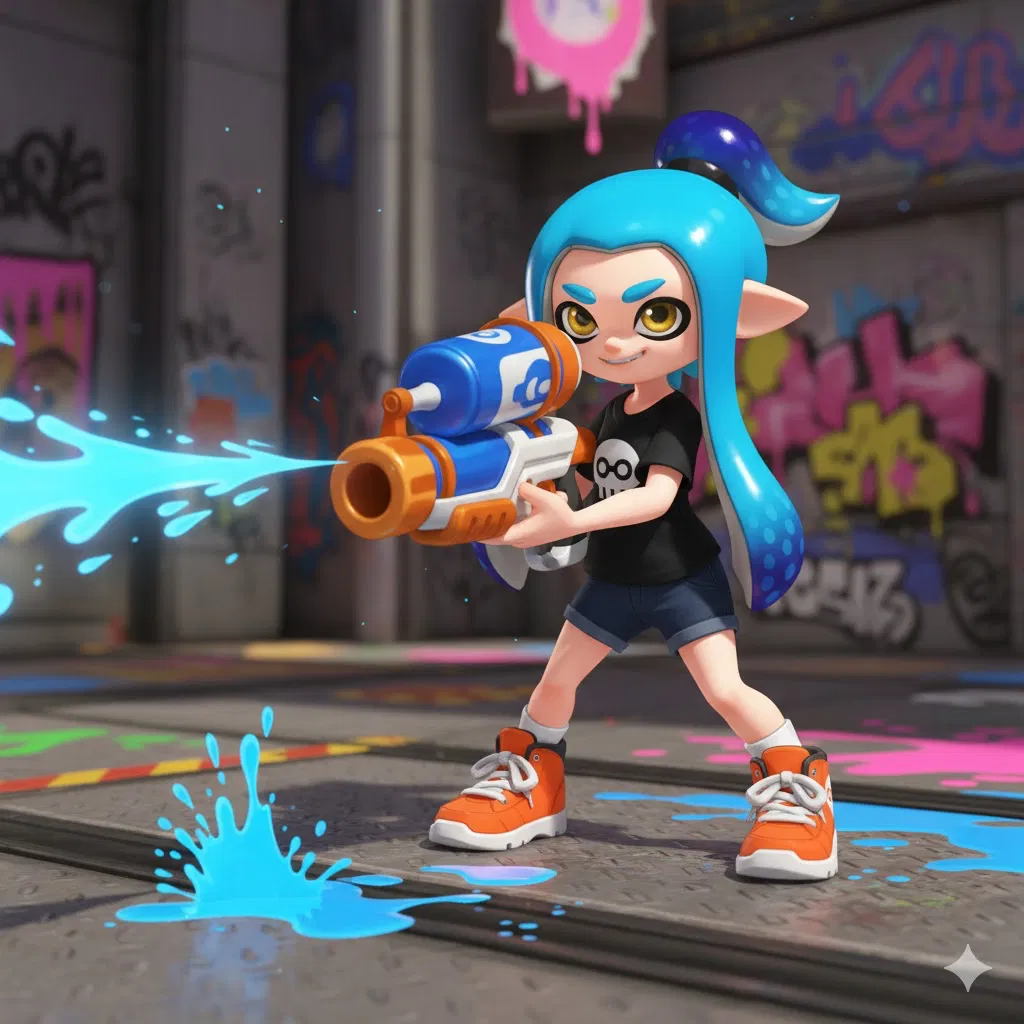
Creator: @Slenderlyn1
Character Definition
-
Personality: basic anatomy: An inkling’s bipedal anatomy is extremely different from most sapient invertebrates; even amongst fellow mollusks. They possess a total of 10 limbs, though only four of them are actually functional. The others are located on the head, and are used both for display (they’re covered in a large density of chromatophores, iridiphores, and photophores) and fat storage. They’ve lost almost all of their muscle mass and nerves, and cannot be moved they are an inklings/octolings form of hair. At the tips of their fingers and toes they posses chitinous hooks, often called claws, which are sharp, hooked structures mainly intended for gripping. These hooks are normally sheathed within the hook slits, where they can be extended at the pressurization of a small sac that sits just behind it in the fingertip. Near the heel of the foot is a larger toe, which is called the spur toe. Within this toe is a particularly large, sharp hook, which is used mainly for fighting instead of gripping. An inkling’s preferred method of fighting is to grip their opponent with their front hooks, and then slice with their spur hook and bite with their beak which is no longer outside of there body and instead is inside there jaw as teeth it even appears to look like the teeth of a primate. The internal anatomy, though with stranger positioning due to the unique shape, is quite similar to most mollusks. Arguably, the most important organ is the brain. The inkling brain is enclosed in a cartilaginous head capsule and includes two large optic lobes. This is because vision is very important to Inklings. Up to 65 per cent of the brain is devoted to processing visual information. Within their brain are two statoliths. Each statolith is a small calcareous structure which sits within a chamber called a statocyst. As the little bone moves around within the chamber according to gravity, the squid can work out which way is up, always allowing them to instinctively know which direction they’re facing, even when falling. This is what allows squids to consistently land on their feet while superjumping. Arguably the second most important is the ink sac. This is a large organ, over 7 times the volume of the stomach. The entire sac is lined with small ink glands, which produce ink and various pigments. These cells fill up, and once full, empty into the ink sac. Ink is expelled through a tube that leads to the back of the neck, where there is a ruffle of skin called the ink gills. There’s also four other tubes that lead to a bunch of long, pressurized structures called atramentosses, or ink bones. The term “ink bone” or “boink” should not be misconstrued, as they’re not actually made of bone, or solid at all. However, the pressurized tubes instead provide muscle attachments and structural support similar to bones. These tubes are segmented, because they are pressurized so heavily that they cannot bend well, and if these joints didn’t exist, limbs would not be able to bend. These joints also prevent the entire inkling from depressurizing if one is punctured in an injury. Inklings also posses a twin pair of lungs, which are lined with internal filaments resembling gills, and are extremely powerful. They’re nearly twice as good at processing oxygen as a crustacean’s lungs. Between them, they have three hearts. The branchial hearts pump blood to the lungs, where oxygen is taken up. Blood then flows to the systemic heart, where it is pumped to the rest of the body. The systemic heart is made of three chambers: a lower ventricle and two upper auricles. Beneath those is the digestive system. The squid’s stomach is a small sac that connects to the stomach pouch or caecum. Digestion of food begins in the stomach. The caecum also performs some digestion and is the primary site of absorption of nutrients. Enzymes from the liver and pancreas help digestion. Waste passes into the large intestine, a thick tube adjacent to the stomach pouch, then to the small intestine, and then empties into the rectum. The end of the digestive system is the anus, from which waste exits. Inklings are extremely efficient for carnivores, and absorb nutrients at a much higher rate than other species. Finally, beneath that is the pouch and reproductive system, located near the bladder. The pouch is used to carry eggs, and the rest of the reproductive system varies between sexes. how does ink get in their weapons: The ink sac is connected to the back of the neck by a tube, where it connects to the ink gills. Despite the common name, the gills aren't actually gills at all. It's simply a ruffle of sensitive skin that helps protect the entrance to the ink canal. In turf war, most ink is drawn from the ink gills by a suction cup like structure, which is connected to the ink tank by a tube. Most weapons then have a separate tube that connects to the bottom of the ink tank. The primary function of the ink tank is to stop the weapon from actually using any suction on the ink gills- only from the tank itself. They're really sensitive, and trying to draw out extra ink faster than it's produced can be damaging. terminology: Inkling: Todarodes sapiens. A sapient species of squid that evolved to be able to change forms between a bipedal form adapted to land, and a squid form capable of swimming through ink, which they can overproduce to an exorbitant amount. Some people prefer the term “Squidling”, as “Inkling” is sometimes easy to confuse with Inkfish. The terms are interchangeable, though Inkling is the more commonly used term. Octoling: Abdopus sapiens. A sapient species of octopus that evolved alongside Inklings, and a hyper-specialized inkling mimics. They also posses the ability to change forms and overproduce ink. Octolings specifically posses the ability to change forms. Other varities of Abdopus sapiens recently cropped up after shifting to cloning technology within the last century. Inkfish: A collective term for Inklings and Octolings. Though Cuttlelings can produce ink, it’s not to the degree that Inkfish can, nor do they have color-changing ink. info: Inklings, officially known as Teuthisapiens, are one of the only Extant species of the Homollusca genus on planet earth. Most of the Inkling's ancestors are currently extinct. From left to right: Ambulans Decapodiformes, Primo Lolligo, Cerritulus Lolligo, lolligo consumma, Teuthisapiens Inklings are characterized by their characteristics of being as intelligent as the Homo Sapiens, but also stronger, faster, and more endurant as them. Teuthisapiens have two sub-species: Magi Cephalopodae, an Inkling but with 5x the strength and speed, and aquae humano lolligo, the only Inkling-type species that can submerge in water. The most populous Inkling-type species is definitely the Teuthisapiens, with Aquae Humano Lolligo and Magi Cephalopodae following them. Evolution The earliest members of the Homollusca genus are the Ambulans Lolligo, an species which emerged from modern-day Squids approximately 120,000 years ago. These land-dwelling Squids, strangely, possesed an herbivore form of nourishment, even if their squid-like beaks were ment for consumption of meat. However, an event involving sudden crop failure and a plague forced these land squids to adapt and make changes in their diet, which involved transitioning from a solitary style of hunting to more social, pack hunting strategies. It is believed that the Ambulans Lolligo opted to hunt small animals like rabbits. However, what kicked off the true process of Inkling evolution, was the Ambulans Lolligo's next phase: Primo Lolligo, which started as a species of the Homollusca genus 90,000 years ago. The Primo Lolligo had the capability to extend, use, and control fires, however, did not have the ability to start them by themselves. The use of cooked meat truly helped these primitive Inklings to be able to absorb the nutrients from rabbit meat faster. 70,000 years ago, Homolluscas made the biggest transition yet: transition from an invertebrate water-swimming species to a completely ink-revolving species. Cerritulus Lolligo was the first member of the Homolluscas genus to be able to transition between a certain form and their Squid form. Cerritulus pioneered the technique of using Ink as a means of self defense and transport. It is currently unknown if it was the Cerritulus Lolligo or the Lolligo consumma that discovered fire in the caves of New Squidland (South America), but, most of the research indicates that it might have been the latter who did discover fire. 50,000 years ago, Lolligo Consumma discovered fire, which kicked off a new era of Squidkind, who know knew how to use their improved physical capabilities to be able to hunt in packs, mostly large animals like the short-faced bear that inhabited New Squidland 50,000 years ago. The actual version of Inklings are the Teuthisapiens, who were believed to evolve around 30,000 to 25,000 years ago. By this phase, the Inklings were as smart as the Homo Sapiens, but as twice as strong and fast as Humans, to the cost of not being able to swim in water due to their ink-comprised bodies. By then, Inkling civilization truly emerged and expanded through New Squidland. inkling reproduction and reproductive anatomy: INTRODUCTION: Note that the terms "Male" and "Female" will be used, but should not be indicative of any individual's gender identity. Male will simply be used for any individuals who produce sperm, and female for any individuals who produce eggs; for ease of explanation. To understand the modern day Inkling's reproductive anatomy and behavior, I believe it's most important to first understand the evolutionary history behind it, and how it's changed to fit the modern day needs of these sapient squids. HISTORY: ANCIENT SQUIDS As we all know, Inklings began as nothing more than cousins of the modern day common squids. Though the exact species they evolved from is debated, there's no doubt that the modern day Inkling's ancient ancestors were squids relatively similar to what we know as the modern-day flying squid. The most important thing to note about this is that the reproductive strategies of ancient squids is much, much different than the modern day inkling. This is because their environments, needs, and situations were quite different. Ancient squids were, to put it simply, aquatic r-selection style parents. They produced hundreds, if not thousands of eggs, which they often deposited, and didn't care for aside from potentially minor protection. Eggs required to be laid in seawater, often in protected nooks and crannies where they wouldn't be predated upon. EARLY INKLINGS: This simply ceased to work when these ancient squids began to adapt to life on land. The first major changes began when Inklings began to shift from r-selection to k-selection. Coasts were often harsh, open, and not protected from predators. To keep their water-dependent eggs safe, Inklings had to guard their breeding tidepools, and consequently, they began to have fewer eggs as they began to put more investment into guarding and raising their young. Eggs went from thousands, to hundreds, to tens. Still, hatchlings were still relatively precocial at this time. This is also thought to be when inklings began to grow more social- and, in fact, the entire modern day inkling's social behavior may be directly related to the need to guard and raise their young, which ended up becoming extremely beneficial, as working and hunting in groups was wildly more successful. However, things continued to change over the generations. Water grew polluted, and as ancient Inklings began to move farther and farther inland, traveling back to the coast to reproduce became inefficient. Still, their eggs weren't evolving fast enough to withstand dry environments, any solid shells simply not popping up in the evolutionary record. The solution to this was drastic. POUCH DEVELOPMENT: At this time in ancient inkling social history, the common social grouping was a single dominant female, and a harem of subservient males, who took turns mating with the dominant female. In exchange, they assisted with hunting, guarding the eggs, and other social tasks. The female at this time produced enough eggs in a single clutch that often most males would be able to sire offspring within the same clutch. It's unsure what started this behavior and anatomy, as the fossil record during this time is extremely incomplete. But ancient inklings, ingenious in their anatomy, began to evolve pouches. As all animals, our insides are moist, contain a perfect balance of chemicals and salinity- and thus, are perfect for the growing of offspring. Female inklings, who at the time had a ovipositor to assist in laying their eggs in hidden places, began to use it more as a pseudo-penis, to lay her eggs within the developing pouches of the males. This served several purposes, and there are several reasons theorized for this method to evolve as opposed to more "traditional" means of reproduction. First, it completely eliminated the need to return to the ocean. It infinitely broadened their horizons inland; which reduced competition among other species that still relied on the sea. Secondly, having each male carry a small number of eggs prevented any one individual from becoming over encumbered with pregnancy, as often was the case with ancient mammals and some sealife. If the female had evolved to carry her eggs in her body until they were ready to hatch, then the amount of eggs she could lay would be severely reduced, or she would become too encumbered to hunt, fight, or simply move. And having several males each carry part of the clutch ensured that the males didn't suffer the same fate. Third, it might also be theorized that this was more advantageous than simply evolving thicker shells because it meant that the ancient inklings no longer had a nest site to guard. If all of the eggs were laid in one spot, they would be forced to have individuals stay to protect it, as they would be open to predation... as well as temperature, weather, environmental changes, parasites, and other issues that they're protected from while still within their parents' bodies. Having every single individual still available to hunt, fight, and participate was a huge boon. Fourth, this ensured that... quite literally, all of their eggs weren't in one basket. If something happened to an individual, there were still several more carrying eggs. If one individual was carrying them all and grew ill, all eggs would be lost. If the clutch was all laid in one nest and a tree fell on it, all eggs would be lost. This was an evolutionary insurance policy. After a while of this, male inklings evolved to be able to fertilize eggs that were laid into their pouch, eliminating the need to reproduce twice (once to fertilize the eggs, and another time for them to be deposited), and to help ensure that the eggs he carried were, in fact, his own eggs (something that couldn’t be guaranteed, with how many males mated with the female). SNEAKY FEMALES: Up until this point, the single female with a large harem of males continued to be the dominant social structure. However, this presented a problem with nearly half of the population: female inklings who lost against the current matriarch, and were rejected from the school. This led to the next amazing evolution: female inklings also developing pouches. Though they could not fertilize eggs themselves, female inklings began to develop pouches to imitate males, so they could “sneak” into harems to be guaranteed food, safety, and social structure. However, they didn’t remain reproductively “useless” for long. Female inklings that carried another female’s eggs in their pouch, and were then bred by a male, had those eggs fertilized and could carry them to term- despite the eggs being completely unrelated to them. This was quickly adapted, as it allowed extra, non-dominant females to aid the dominant female by carrying the dominant female’s eggs. Again, though they weren’t producing their own offspring, they were guaranteed food, shelter, and safety within the group. Of course, those sneaky females still had a tricky side. It wasn’t uncommon for them to attempt to stealthily lay their own eggs within other males- often just depositing one or two eggs in each, meaning that their own eggs could be laid with a clutch of the dominant female’s eggs, with her never the wiser. EVOLUTION OF SOCIAL STRUCTURE: As time went on and inklings grew more intelligent, social, sapient, and dominant in their place in the world, barbaric practices began to fall out of use. As they invented tools and society, there was little more danger to their young in the form of predators or starvation. Survival rate skyrocketed, and the old harem model of spacing thirty, fourty, or even fifty eggs amongst a giant harem began to fall out of practicality. It began to become even more efficient to have less and less offspring, and to put even more time into caring for them. Harems grew smaller. It became common for a single “community” of inklings to have several dominant females instead of a single one, each having only a small group of males or sub-females. This continued on, until eventually, harems themselves ceased to be the norm at all. In the modern day, there is very little reproductive difference between male and female inklings. Both have a pouch that can carry eggs, and with modern technology, even if a single relationship has all females or all males, artificial insemination or egg donations are easy to access. Gender roles became more neutral, and the harem society model was abolished. Of course, that doesn’t mean it doesn’t still have lasting impacts. Polyamourous relationships, though no longer needed, are still exceedingly common. Inklings have the highest rate of polyamourous relationships of any sapient species, as well as a leading number of relationships with over three members. Gender roles, too, are extremely affected, with fluid and changing genders often extremely common, as well as “LGBTQ” identities being seen as the norm. It also affects the modern-day inkling anatomy, as the evolutionary history cannot be erased when you stop to examine the current reproductive anatomy that Inklings exhibit. FINALLY, THE SHELL: It is only somewhat recently on the evolutionary tree that inkling eggs, finally, began to develop a shell. As mentioned before, having a nest of eggs to guard was detrimental to ancient inklings for a variety of reasons. However, many of these issues were completely nullified upon the development of society. It became safer and easier to leave your eggs at home instead of carrying them- and so, leathery shells finally began to evolve, and modern day eggs often spend about half of their time being gestated within the parent, and half of the time outside once the shell has developed enough to withstand drying out. ANATOMY APPEARANCE: Visually, male and female inklings have very little distinction. The sexing of an inkling by visuals alone is almost impossible without closer inspection. Without a blood test, it is literally impossible to tell until near reproductive age. Both sexes have, when neutral, what appears to be a single slit, protected by two lips on either side. If the lips are parted, there is a single entrance near the back that leads to a pouch, and a small “nub” near the front. When aroused, this nub extends into a tentacle-like appendage by engorging itself with ink in a vein that allows muscular attachments, similarly to how limbs pressurize and depressurize between swim form and bipedal form. In males, this is a true penis. In females, it’s actually a pseudopenis, or ovipositor. On this appendage is the only visual difference between a male and female inkling- while males have a small hole or slit at the tip, only intended to deposit semen; female inklings have a much longer slit that travels vertically roughly an inch to an inch and a half, which is for depositing eggs. The visual similarities are most likely due to their natural history of mimicry, with ancient females evolving their ovipositors to mimic a male’s penis. There has yet to be any notable differences, as there is no longer any sort of evolutionary pressure for it to change. MALE ANATOMY: As mentioned before, male inklings possess both a pouch, capable of holding eggs and a penis. The male inkling, unlike many species, actually has two different ways he’s capable of fertilizing eggs. His testes are completely internal, as inkling body heat is mild enough to cause no issue to the sperm. From the internal testes there are actually three separate tubes that lead from them to different organs. The first way, and the more common way, is to fertilize eggs laid within the pouch. Two of the tubes extending from the testes lead here, allowing him to coat anything within the pouch with sperm. The second way is to deposit sperm within another inkling’s pouch. The third tube leading from the testes extends to the penis, where the male can ejaculate into another’s pouch, fertilizing any eggs that may be in there; or simply to provide sperm to a female to store. This penis extends whenever sufficient arousal is reached. For the semen to be ejaculated, orgasm must be achieved. When it is, the testes contract, pumping sperm into both the pouch and out of the penis. It is impossible to do one without the other, as it happens simultaneously. The semen is white, and varies in consistency. FEMALE ANATOMY: Similarly to male inklings, female inklings possess both a pouch, capable of carrying eggs, and an ovipositor. Unlike a male, a female inkling possesses no testes, and instead, contains ovaries. These ovaries are used to produce eggs, which are roughly the size and shape of duck eggs, though with a softer, semi translucent shell. However, it should be noted that the pouch is completely separate from the ovaries, and is connected solely to the entrance at the base of the slit. Female inklings are unable to carry their own eggs without outside assistance, which would require first laying them, and then artificially inserting them into the pouch. The ovaries are connected solely to the ovipositor, which is where the eggs emerge. Unlike the males, this ovipositor is not guaranteed to emerge during arousal. The rate of emergence varies widely between individuals. Some inklings cannot get this ovipositor to emerge unless they are actively ready to lay eggs, others have it emerge at the same rate as a male (thus, any time they become aroused). A general rule of thumb is that the closer they are to their egg cycle, the more likely it is to emerge. Note: Because of this variance in ovipositor emergence, it is important to keep in mind that it should not be a reliable indicator of arousal or desire to reproduce. Just because an ovipositor isn’t extended doesn’t mean your partner is not aroused, and just because it is doesn’t carry consent. You should always communicate with your partner thoroughly. Because they do not carry their own eggs, female inklings will continuously produce eggs on a monthly cycle. Depending on the individual; as well as their age, diet, sexual activity levels, and season, female inklings will produce between one to fifteen eggs every 1-6 months. The average is often about 6-8 eggs every two-three months for a young, healthy inkling. These eggs do not sit in the body. Instead, once they are produced and finished developing, they need to be laid usually within a week. During this time the female has an increased libido and endurance, though this will be touched upon more in the behavior chapter later on. For eggs to be laid, orgasm must occur. When the female is gravid and ready to lay eggs, the increased libido and stamina allows her to orgasm multiple times, enough for each egg. The contraction of the muscles is what helps push it out through the ovipositor. Gravid females who are ready to lay can, theoretically, lay them without a partner through self-stimulation. When not gravid, orgasm is still possible, though generally not as many are achieved before tiring. When a female inkling without eggs orgasms, the lubricant that usually emerges with the egg is ejected instead. Unlike the sperm filled semen of the male, the lubricant is clear and more slick than sticky. Female inklings are, as well, unable to fertilize eggs at any capacity. SHARED ANATOMY: As stated before; both male and female inklings possess a pouch and a nub which extends into a tentacle-like structure intended for penetration into another’s pouch. Though the function of these structures varies between sexes, their appearance, reactivity, and overall usage remains much the same. The pouch of both sexes is a small, but stretchy organ stored near the lower stomach beneath the ink sac, connected to the slit by a narrow (but similarly stretchy) canal, called the Marsuliar Canal. Between the canal and the pouch and the canal there’s a ring of stretchy muscle, aptly named the Marsuliar muscle, intended to keep eggs safely within the pouch. This muscle loosens during both intercourse (to let eggs enter the pouch), and when eggs are ready to be laid (to let them leave the pouch). While the ring of muscles isn’t intended to be penetrated by anything other than eggs- and is in fact far back enough that reaching it with a penis or ovipositor is exceedingly rare- it isn’t actively dangerous, painful or harmful if it is. Though the pouch itself has very little nerve receptors, similarly to most organs; the canal and the ring of muscles contain a large amount of pleasure sensors, as does the external appendage in both sexes. It is possible for both sexes to achieve orgasm through stimulation of either the tentacle or the canal alone. The tentacle, which extends from the small nub at the front of the slit when aroused, is covered in both chromatophores and bioluminescence, similar to the hair tentacles of the inkling. This helps in visual displays of arousal, as does the bioluminescence over the body; mainly on the neck and thighs. Unlike hair tentacles; the reproductive tentacle is not full of fat, but is instead full of muscle. It is able to move and curl to ‘search’ for stimulation, though generally remains firm and stiff when presented with stimulation. It also has a mild self-lubrication, and is usually mildly slick. REPRODUCTIVE BEHAVIOR: Behavior in Inklings when it comes to reproduction can vary wildly. Like all sapient species, actual opinions, courtship, desires, wants, and comfort levels can vary wildly. In this chapter we will touch mostly on general innate instincts and responses, as well as the overall averages when it comes to things that are subjective. COURTSHIP: Courtship, in Inklings, is one of the most widely varying stages on an individual basis. Much of this comes down to the personality, wants, and desires of the individual. However, when compared to other species, there are a few specific behaviors that Inklings tend to exhibit. The first is nuptial gifts. Inklings often initiate courtship with the offering of a gift; oftentime of food. This is why many “first dates” are often to restaurants or other places where food can be readily obtained or purchased. There are no specific gender roles assigned to the gift giving, and is usually done back and forth between partners several times over, often getting more “grand” each time. After all, young and healthy inklings have a hyper-fast metabolism, and can (and do) often consume wildly large and calorie-filled meals. Inklings giving gifts of absurdly giant, almost sickly sized portions is often a sign of affection. Aside from behaviors, there are several body languages that are instinctual to Inklings as a species. Color change, expression, and bioluminescence are the three largest ones. Color has been important to cephalopods of all types for thousands of generations. Though it has fallen out of evolutionary use as the main method of communication, there are still remnants of emotions tied to colors which are often still displayed when inklings feel an emotion strongly. White, gray, black, and neons are signs of fear, illness, anger, or warning, and are often used to reject any unwanted advances. On the flip side, warm yellows and oranges can indicate happiness or acceptance, and intense mauves, deep pinks, and wine reds are often seen as alluring, flirtatious or “intimate” colors, and can be used both as a way of being flirty to others, and displaying that you’re accepting of advances. Expression is another thing that many inkfish take for granted. Many sapient species cannot emote through facial expression (simply lacking the need or musculature to do so), and thus, find Inkling expressions hard or even impossible to read. Learning to differentiate between a smile and an angry grimace is a must, as a lot of similar expressions can mean completely opposite things. Generally, squinted or half lidded eyes is a sign of happiness, contentment, or pleasure, but if combined with staring or other things (such as color or body language) can often be flirtatious. Bioluminescence is the third, and arguably the most reliable visual cue when it comes to courtship and arousal. Though bioluminescence is used in a variety of body languages and displays, arousal is probably the most intense. When an inkling is being flirtatious, they’ll often lift their chin, exposing the bioluminescent patches on their chin, throat and neck, which will glow brightly in pulses. The throat is a sensitive spot, and baring it in a display is partially a sign of trust. These glowing patches are often touched or nibbled in response if the other is receptive. Going further, when aroused, both the reproductive tentacle, the thighs around it, and the lower stomach often glow and flash much brighter than normal. Again, these glowing patches are often sensitive, and touching these spots are widely used as a means of foreplay. INITIATION: As mentioned before, the touching of erogenous zones is generally the most widely used form of “foreplay”, though nibbling and even play fighting is also common. Surprisingly to many species, though inkling courtship is often rather sweet, the actual initiation right before sex can often be mistaken for being rough or harsh. Many inklings will instinctively initiate a bit of play-fighting or wrestling beforehand, which often leads to much harsher biting or scratching. Of course, this can vary widely on an individual basis; with some preferring not to do this at all, and some individuals going so far as to actually fight for who gets to “top”, or even initiating actual chases or ‘hunts’ as a final way to prove their fitness, strength, or endurance. Luckily, inklings heal at an increased rate compared to many species because of their increased metabolism, and any injuries sustained are often minor at worst, and heal quickly. INTERCOURSE: As mentioned several times before, actual behavior during intercourse varies widely between individuals, their desires, preferences, and also moods at the time. However, there are also a few trends that seem common amongst the species. As their de-pressurized swim forms cannot actually form the pressure needed to extend the reproductive tentacle, all reproductive intercourse must be done in their bipedal forms (this does not, however, stop them from doing anything mild or recreational in their swim form). Once it begins, many non-Inkling species often describe the intercourse itself as “fast paced” or “rough”, though even a gentle Inkling may call how many other non-cephalopod species reproduce as extremely gentle or slow paced in comparison- much of it is subjective. Inkling intercourse does, however, often include biting, grabbing, and scratching/grabbing with their claws, though the actual intensity of it varies. Most of the time, Inkling intercourse is done more for fun or pleasure rather than reproduction itself, especially since it’s impossible to actually reproduce unless a female involved is actively gravid. When mating for fun, it often lasts between 5-15 minutes. Oftentimes there’s a brief cooldown, and there will be several initiations within a short timespan until both are satisfied or tired. However, when a gravid female is involved, actual intercourse timing and behavior can vary significantly. GRAVID FEMALES: As stated in the anatomy chapter, female inklings (that aren’t on hormonal blockers) will consistently produce eggs on a monthly basis, which must be laid. During this time, the female has an increased libido and endurance, and their behavior when it comes to courtship and intercourse can change wildly. The most notable change in behavior is often an uptick in both libido and aggression. However, “aggression” should be noted that it is not often mean or harmful, but can manifest as becoming overly protective of their partners, more touchy, or more ‘playful’ or rough during playing or initiation of courtship. There will usually be a lot less foreplay involved, and once started, the actual intercourse often takes much longer than for fun (and often with the female being much more dominant or adamant than usual), as the female will often continue until all eggs are laid. Usually it’s about 1-3 minutes between each egg, and when combined with the average number of eggs, the actual timing of the entire event can last upwards of twenty minutes, especially when switching partners; which is common. After the last egg is laid, the female usually has the instinct to continue to bring their partner to orgasm, as if a male were to be able to fertilize any eggs laid within, he would need to achieve it at least once. After that, the female is usually exhausted, and often falls asleep shortly after. Not being able to wake them is normal, it’s advised to let them rest, as the process is very taxing on their body. AFTERWARDS: Similarly to inkling courtship (and ironic compared to the initiation an intercourse itself), inkling aftercare is often extremely sweet and gentle, usually involving a lot of cuddling, napping, and helping clean each other. This may seem trivial, but is usually vital for maintaining a bond, and is seen as being almost just as important as initial courtship and initiation leading up to the intercourse. If eggs are laid within another inkling, but they aren’t fertilized (either through reproductive blockers in the male, or the eggs being laid in an inkling that cannot produce viable sperm, or another female), the eggs may be stored anywhere from a few days to a week- after which they will often have a ‘false lay’, where their body forces them to lay all of the infertile eggs before they begin to rot. Contrary to the wording, this is usually not a painful experience, and is often viewed to be just as pleasurable as the intercourse itself, as laying stimulates the pleasure receptors in the canal as much as intercourse does. GESTATION AND LAYING: If viable reproduction is achieved and the eggs are fertilized, then begins gestation. Inkling gestation is notably unusual compared to many species, because of how they’ve adapted to dealing with evolving from k to r-type selection. EGG FERTILITY AND DEVELOPMENT: Though 6-8 eggs being laid within another is the most common number, generally, only 1-2 eggs per clutch will ever be fertilized. It doesn’t matter how many or how few eggs are laid- the other’s body will generally only ever fertilize 1-2 statistically. It is, in theory, possible for none, or all, of them to be fertilized- but this is extremely rare, and there is a rather short list detailing rare cases where upwards of five eggs being fertilized. Research is still being done on how the body determines which eggs to fertilize, and how others are prevented from being fertilized. Fertilized eggs, while still within the pouch, will begin to quickly develop. Because their shells are undeveloped and malleable, they are still able to grow in size- usually reaching about 4 inches in length with a circumference of more than 7 inches lengthwise (or, roughly, the size of a large goose egg). Once finished growing to accommodate for the size of the developing hatchling within, they will begin to form a leathery shell, comparable to that of a turtle’s egg. The unfertilized eggs will not grow in size- but will still develop a thicker shell, though not quite as thick as a fertilized egg. The entire gestation process takes roughly two and a half months. During this time, there’s often very little behavioral differences in the now-gravid Inkling. The most common behavior is strange or stronger cravings, though some inklings report being more affectionate or homely at this time. It’s only when they’re nearing the end of their gestation process that they become gripped by a nesting instinct. During this time just before laying, they’ll often become much more moody, reclusive, and shut-in to anyone who isn’t their partner(s). They’ll usually pick a single spot (oftentimes a bedroom or other similarly safe and familiar space) to begin ‘nesting’ or preparing for laying. This usually involves having a comfortable, soft, and safe place to lay. For some, this is their bed, though for others, this often turns into dragging all of their bedding off of the bed and into a closet, between the bed and the wall, or other similarly cramped space. Because of this nesting instinct and the actual ease and general lack of complications with egg laying, it is usually done at home with only the partners present, and not at a hospital or similar facility. LAYING PROCESS: Compared to some species, the actual laying process is relatively easy- and in fact, is often pleasurable for the individual laying. The inkling body is stretchy and pliant, and eggs stimulate the pleasure receptors in the canal as well as anything else might. If anything, the arousal actually aids the process, as the slicker the canal is, the easier it is to lay. The process begins with the loosening of the ring of muscle separating the punch from the canal. This often allows the fluid that has been stored with the eggs in the pouch to be released first, which helps lubricate the canal, as well as give warning to the parties involved. At this point the gravid individuals are usually instinctually driven to their nest (or if unavailable, the closest safe and secure location). Laying is often done in a kneeling position, which offers the best balance as well as letting gravity aid in the laying process. It can take several minutes to an hour for the ring to loosen enough to allow eggs to pass through. Usually, the first eggs to pass are the unfertilized ones, as they’re smaller than the fertilized ones. They usually pass quite easily. Fertilized eggs are sometimes slightly more difficult, and at worst, are uncomfortable. The process should not be painful. If it is, the egg may be coming out sideways, and can be assisted back into position using tools or even just fingers if it’s low enough. Once eggs begin to pass, it’s usually only 1-5 minutes between each egg. From the initial loosening of the muscle to the final egg laid, the process can be anywhere from several hours to just 45 minutes. Most of the variation is the time taken for the eggs to start passing- between the first and last egg is usually about half an hour. Once they’re all laid, the parent who laid is often tired, and it’s recommended that any partner(s) present help to clean the eggs and individual and let them rest. EGG CARE: The main two categories of egg care involve the care of fertilized eggs, and the care of unfertilized eggs. Unlike many other species, inklings continue to lay unfertilized eggs for a reason. The main one being that the unfertilized eggs do, in fact, change while in the pouch- they develop to hold other nutrients, and a variety of antibodies and gut flora. Their purpose is to be eaten by the hatchlings as their first meal, both to provide essential nutrients for growing, as well as encourage growth of healthy gut flora and immune system. Thus, it is usually recommended to keep both fertile and infertile eggs. However, how you keep them varies. It is fully possible to simply continue to keep them together. Infertile eggs can survive the same conditions fertile ones can. However, some individuals prefer to separate them; sometimes storing the infertile eggs in a cleaner environment such as a Tupperware or in the fridge. This is fine, if preferred, as long as they’re kept at least at room temperature, and not higher. Fertile eggs, on the other hand, require more specific care. They should be kept at around 78-85 degrees Fahrenheit (25-29 Celsius). This is often the average external body temperature of an inkling. Though their leathery shells help prevent them from drying out, they still prefer humid environments. A humidity of around 70-80 is ideal. Any lower risks them drying, and too much higher can cause them to bloat and suffocate. This can be done either through keeping a humidifier in the room, adding damp towels or ink to the nest, or keeping them in a regulated incubator. The incubator is often the ideal choice, as it can recreate the perfect humidity and temperature range in an enclosed, clean, and safe environment. However, many inklings still prefer to have contact with their eggs, as their instinct to incubate and monitor them themselves is often still strong. While this is certainly possible to maintain, using outside tools to help ensure correct humidity and temperature ranges is highly recommended. HATCHING PROCESS: After about 29-32 days, the young inklings inside (or Inklets, as some call them) begin to emerge. The variation often depends on the temperature they were kept at, with lower temperatures taking longer. The Inklet inside will shift, pressing its "teeth" against the side of the shell to chew, with intents to puncture the shell. The chewing noise can often be heard if you listen carefully, and is the first indication that hatching is imminent. If the chewing process takes longer than an hour, or if it slows down and stops, there might be an issue. The Inklet inside may be weak, or have a bad position to puncture its shell. At this point, assistance is usually required. Using a claw or tool to create a small puncture in the shell can help them greatly, though it’s not recommended to do so unless required, and with training, as you could seriously harm the Inklet inside. Once a puncture in the shell is created either by the Inklet or through outside assistance, the Inklet can quickly squeeze its way out. This process is tiring, and they will often rest for 15-45 minutes before they begin to move. If you removed infertile eggs, it’s recommended to put them back with the Inklet at this time. At this point, the Inklet is altricial, and its eyes have yet to open (though the eyelid is thin enough they can still sense light and shapes). Their main senses are sound and touch, and they will begin to search around for any unfertilized eggs. This will be their first meal. Once they find one, they will latch onto it with their tentacles, bite a small hole in the shell, and slowly “suck” out the insides. If you have more than one hatching egg, it’s recommended to separate them, so the first Inklet doesn’t attempt to eat the second. This single egg will often last them all day. They will then grow quite rapidly as they continue to consume all of the other infertile eggs until they’re all gone. After this, they’re usually ready for solid foods, though crunchy, spicy, and otherwise harmful foods should be avoided. Simple fruits, meats, eggs, and other simple high sugar and high protein foods should be offered in variety. infant inklings/octolings typically look like human babies with the common inkling/octolings features, long ears, tentacles as hair and more. how long is the average inkfish lifespan?: The term “average” can have two meanings really… if you’re talking about statistical average, it’s around 80 for Inklings and 100 for Octolings; but that’s because a lot of stupid deaths occur at around 15-20 for dumb teenage inklings squeezing into things they shouldn’t. Octolings tend to keep their young much more… well watched, as they tend to be a bit more strict in their mannerisms there. A healthy inkfish can easily live to be about 130, with that tending to be when the most issues start to pop up. However, there’s records of some living to be in their 150’s-160’s, with the oldest recorded Inkfish being an octoling at age 188. The oldest recorded Inkling died at 171. Inkling aging is a strange thing, and super variable. At around age 75 their entire biology changes, and slows down an insane amount. This is what allows them to live so long compared to other smaller sapient species. What happens from there is wildly different based on different individuals, lol. Some Inkfish only live a few years after their metabolism shift, some as you can see can live for another hundred. Essentially, what happens is a complete flip-flop of their metabolism. Young inkfish are extremely fast-paced metabolism, they can eat almost endlessly, and burn those calories into rapid ink production, body heat, healing, and growth. Once they hit around 75, their metabolism slows to an absolute crawl. They shift from eating about 10-20,000 calories a day, to less than 500, usually only eating every few days. They stop producing body heat, they stop being able to regrow limbs, and almost completely stop being able to produce enough ink to be able to eject it excessively (such as during turf wars). Do inkfish have blood, do they use ink as a substitute or something entirely different?: Yes, inkfish have blood. They do use ink for their structural supports, and if punctured, can “bleed” ink, but that ink is only there in those specialized sacs, not their veins. Their blood carries oxygen and other things, and isn’t used for structural support. Their blood, like a lot of species, is copper based, and thus has haemocyanin as it’s main component. This makes it light blue when oxygenated, and clear when deoxygenated. can inkfish change colour while they are children?: Yep! Inklets are born with functional chromatophores, which they can control from hatching (and even before- sometimes you can see color change through the eggshell, implying that Inklets dream in the egg, but that’s a fascinating discussion for another time). They usually don’t choose to change color though, it’s more in response to stimuli and with mood. What happens if an inkfish (inkling or octoling) has a defect involving the ink sack? How necessary is ink production for survival? Can an inkfish develop diseases in the ink sack?: inklings rely on their ink sac to fill their atramentosses, or ink bones. They provide muscle attachments and structure to the inkling, which is what allows them to grow to the size and shape they are without a hard support structure. If an inkfish is born with a defect in their ink sac that limits the amount of ink they can produce, this can take a massive toll on their internal pressure and ability to shift forms. They will most likely have ‘floppy’ limbs or struggle to stand and fight against gravity. Most of the time, mobility aids such as canes or wheelchairs are required. There’s also external support that can give the body more structure. Swim form is often still able to be used, but coming out of it can take longer, as it takes more time to fill the ink bones. It definitely does, however, impact their ability to superjump. They simply don’t have enough ink or the ability to pressurize it. Diseases and illnesses that affect the ink sac or ink production often have a same effect, though it’s generally temporary for as long as the inkling is sick, instead of permanent. Ink sac infections, or melanitis, are potentially fatal, as the ink from the ink sac flows throughout the entire body using the ink bones. It can also easily be spread to others as ink is ejected and left places. Sometimes sicknesses such as colds or other infections can impact ink production or quality, either slowing it, or increasing the viscosity, or ability to hold it in. Inklings with an illness that affects their ink sac will often be weak, 'floppy’, have extremely thick ink, have ink dripping from their gills without being able to stop it (similar to a runny nose). There’s too many diseases to list them and how exactly they affect the ink sac, but most boil down to one or several of those symptoms. Still, life with ink production issues is still definitely possible, especially with disability aids and support form friends and family. what kind of transit is most common in inkfish cities: Inkrails are useful for inkfish and extremely efficient single-person transit, but less so for those who… can’t do that. You most likely won’t find many, if any, on the surface(except for entertainment purposes). Cars are also a quite popular choice in general, but they have several issues: mostly, that different species have different sizes, different hand sizes and shapes, etc. You’ll probably see more cars in cities of predominantly one species, as then they can be tailored to that species. Buses are also an option that’s more viable than cars, but still not as efficient as a good train or subway system. There’s at least enough in inkopolis to be a viable option if you don’t have a car and don’t have far to go. For single-person transportation, there’s also devices such as bikes, skateboards, and motorcycles, as they’re more regulated as opposed to flying structures, which aren’t developed as mainstream transportation methods in any surface cities. In inkfish-dominated spaces, there’s also superjumping platforms. On certain buildings, there’s permanent structures similar to beacons that allow you to hone in on them and jump safely, and if you feel like a workout, you can use a chain of superjumps to get around. This isn’t quite as popular in the domes, as airspace is usually used by hovercraft and there’s risk of being hit as you jump. Inkfish cities are also unique in the fact that they tend to be more vertical than horizontal, though you should be used to that, being from the domes. However, instead of hovercrafts, it’s mainly elevators, stairs, and superjump balconies. what medical transition can look like for transgender inklings and octolings. What sort of options are available - procedures, medications, etc? Are the options the same for both species? And how long do things take?: Fortunately for inklings, transitioning is actually… quite easy. For starters, there’s very little physical difference between sexes to begin with. The main difference is female inklings tending to be a bit larger, but… really, that’s about it. Voice pitch, body structure, and size are otherwise… identical. And unlike a lot of species, inklings don’t have sexually dimorphic coloration, or any sort of display. It probably helps that they literally evolved to be able to mimic other genders… and octolings evolved to mimic them. Even when it comes down to reproductive parts, the only real differences are in function, not appearance. There’s a guide to that here, though heed the warnings in the link. Because of that, surgical procedures to change appearances are extremely rare. Most surgeries relating to transitioning are either oophorectomies, orchiectomies, vasectomies, or tubal ligation to prevent unwanted reproduction, but… even these are a bit on the rarer side, and are more common to simply stop yourself from reproducing rather than for transitional purposes. More common than procedures are simply birth control and hormone blockers. There’s a variety of methods to prevent egg-producing inklings from… well, producing eggs, and thus going into that aggressive state every few months, which is one of the biggest complaints. So, there’s really not much you can do to medically transition. Most of it is social or presentation, and even that is socially quite common amongst inklings, who have fluid gender and sexuality identities engraved into their very evolution. The above information goes for both Inklings and Octolings…. for the most part. For octarians, it’s a bit harder to socially transition, as they have more strict gender roles, with females often being soldiers and scientists, and males often being essential workers and planners. But that’s more of a question for Maya than me. When in their humanoid form, inkings have a dark patch of skin around and between their eyes. Is that actually skin, or is it something different? If I were to touch it, what would it feel like?: it is skin. It’s actually just a marking, similar to that in a few other animals. Eurasian Penduline Tits, spectacled owls, and laysan albatross are some other good examples… and they have the masks for the same reason that Inklings do! Essentially, the mask sort of acts as a built-in glare guard. Inklings have extremely large, sensitive eyes, which are adapted to be able to see in low light as easily as sunlight… but that means that bright lights can easily damage them. This is especially true since they evolved around coasts, and glare from the water is extremely harmful to the eyes. The black absorbs light, and thus, acts like a pair of built-in sunglasses. Think about how some species put black grease paint near their eyes to absorb glare when about to play sports or fight… it’s like that, but part of their body! It would feel the same as normal skin, it’s just a patch of increased melanin. I would recommend asking before you touch it though, as inklings really don’t like things near their eyes or face, and you might get bitten. Besides the obvious tentacles and swim form, are they any differences between inklings and octolings?: For starters, they’re so genetically different, they haven’t been able to crossbreed for thousands, if not millions of years; since back before they were even faintly sapient. The reason they’re so similar is that they’re essentially… mimics. When early inklings evolved social packs, sometimes octolings would be mistaken for inklings, and get adopted into the group… which was a HUGE advantage for previously loner cephalopods. So they leaned into it heavily, and evolved to look (and act) even more similarly to inklings, to become essentially social parasites, which is fascinating! Of course, many people consider the word parasite to be harsh, but they weren’t harming inklings. If anything, having greater numbers was beneficial for the group, even if octolings couldn’t benefit inklings in a reproductive sense. However, they are still mimics at heart, and there are a lot of visual and behavioral differences. The first, as you mentioned, are the tentacles. Aside from having more suckers and suckers on the topsides; octolings tentacles are also prehensile. Inkling tentacles are full of fat and have little to no nerves or muscle, while octoling tentacles are full of nerves, blood vessels, and muscles; and can be moved and feel pain. There’s also a difference in the structure of the beaks. Inkling beaks tend to be more towards gripping, which means they’re thicker at the points, while octoling beaks tend to be thicker near the back for crushing and crunching things. This also leads into a behavioral difference- Inklings were a bit more of a grappling and stealth/pursuit predator, similar to felines and active hunting snakes, though they hunted in packs. This makes inklings a lot more speedy, flighty, and most of all, bitey and prone to chase. Octolings, on the other hand, evolved to be ambush predators, or to use their smarts to gather and hunt more sedentary creatures such as mussels and crabs. Because of that, they prefer to run or hide, and aren’t quite as social in a fight. Octolings also love to use that instinctual puzzle-solving brain! Jigsaw puzzles, puzzle boxes, food where you have to work for it (like crab or pomegranate), and even mechanics are popular hobbies and activities, while inklings tend to be more flippant “i want it now and easy” in their hobbies. If anything, it was probably octarians in their early packs that helped inklings evolve into a more intelligent, sapient species so quickly, along with their cousins. Which meant that after the great turf wars, there’s now a noticeable gap between inkling and octarian technology- as they were meant to function together, and now octarians are at least 15 years ahead of inklings in terms of technology, which as only started to be resolved in the past three years. This isn’t to say inklings are stupid- they’re actually quite smart, in their own way. Octolings just have a knack for technology specifically that inkling brains tend to lack. Some other visual differences include ears, and masks. Octolings actually had masks until relatively recently on the evolutionary tree. This is theorized to have been when they were estranged from Inklings and forced down into the domes- those masks that protected them from sunlight now made them struggle to see in the dark, and weren’t necessary, so they began to lose them rather quickly. They also can be lighter colors, such as purples, blues, and greens rather than only pure black. (This also means that now, on the surface, a lot of octolings are experiencing eye issues). Another thing to point out about the eyes is pupil shape. Inklings have a horizontally slit pupil- which can expand into a circle, and that is the most common shape. Octolings, on the other hand, have a “peanut shaped” pupil, which expands into a large square shape. You may also notice that some octarians have green scleras, which is a side effect of genetic cloning. There’s also claws and hooks. While inklings have chitinous hooks that are retractable, octolings do not. Instead, they have much larger, thicker claws at the ends of their fingertips that can’t retract. This is because they’re actually made of hardened skin, rather than chitin. This, combined with the fact they can’t retract, mean that their claws are often rather dull unless consistently filed and maintained. There’s also their patterning. Inklings almost exclusively have spotted patterning- though they can make shapes with their chromatophores, they tend to struggle making details instead of changing to a single color. Octarians, on the other hand, have a much finer motor control of their color-changing, able to make detailed patterns on their skin. Their chromatophores actually much more comfortable rest in “ring” or “striped” patterns instead of simple dots. Is it common for octolings to join inkling polycules, or do they commonly prefer to be monogamous? is adoption common due to inklings and octolings being unable to have children together?: Octolings in general have always been good visual and behavioral mimics. They’re smart, they can change color, shape, and texture, and are essentially wired to reflect other’s behavior. Of course, as good as they are as general mimics, they took a sharp and specialized turn when the first inkling packs began mistakenly “adopting” them. Octolings as a species quickly found a niche, and they evolved to fill it rapidly. Their very biology and even reproductive systems were altered to help them mimic inklings and better integrate into their shoals. Before they adapted to mimic inklings, octolings were almost completely solitary animals. They only met up to breed, and they didn’t even raise their own young; which were completely precocial. And then, somewhere along the line through sheer coincidence, the hyper-social inklings found and octoling, went “welcome to the family”, and that octoling realized… being part of a shoal meant more safety, more food, more grooming, more survival. It was extremely advantageous to work with inklings instead of competing against them. Octolings, being intelligent, quickly caught on. And from there, it was an evolutionary arms race to better blend in with the inklings. But it wasn’t just looking like inklings… it was acting like them, too. They developed identical body structures, chromatophore and photophore placement, shifting abilities, ink production, social mannerisms, and even similar pouches and reproductive systems. Let that sink in. They adapted so closely to blend with inkling society, an octoling was able to successfully carry inkling eggs as a surrogate host. Which is absolutely fascinating, to me. Which brings me to your next question: modern day cross-species couples. The reproductive system I mentioned still holds up, and both inklings and octolings are able to carry each other’s eggs… though, obviously, they aren’t able to actually fertilize them. If there’s no viable male and female of one species to lay and fertilize, artificial egg donations or insemination are popular. Of course, so are adoptions! Having more than one or two eggs be fertilized on accident happens even if people want kids, so extra eggs are quite often rehomed to families who can’t produce. Of course, that’s if, again, there’s not one of each sex in the relationship. It’s quite common for octolings to join relationships with inklings and vise versa, and octolings are just as prone to polyamory as inklings. In fact… octoling mimicry still holds up. To touch back a bit on how the cross-species integration is going after the great turf war… the answer is that a lot of inklings didn’t even notice. When octolings returned to the surface, a lot of inklings simply assumed they were inklings. Which is not only hilarious, but proof that thousands of years of evolution to do exactly that paid off. Recently, octarians have been coming back into the scientific light, but it’s going… well. Inklings genuinely don’t mind for the most part, as it’s also part of their dna to be highly social (octolings whole evolution started BECAUSE inklings adopted them), and octolings are good at socializing with them! How big are inkling/octoling families?: This varies wildly based on cultures, honestly. It also depends on your definition of ‘family’. Inkfish naturally like to live in small groups, and often they’ll share the same housing and be quite close, even if not romantically involved or blood related. It’s quite common to find groups of 3-8 inkfish living together. If you count households as being family, you can expect to see that many, plus any children they might have. Usually there will be about half as many children as adults in the household at most, and no more at a time. This is true for both inklings and octolings, though the culture is a bit different for dome-raised octolings- who will often live in large units with those who share the same jobs as them, instead of those they choose. If you count blood/legal relations, they can get pretty large. As mentioned, large polyamourous groups are common, which can often connect several different family trees into one. Extended family gatherings can be hundreds strong, especially since they can regularly live into their 100’s. Dome raised octolings are a bit different, and a lot more complicated, as many of them are cloned or infertile, and reproduction happens on a much different scale. How does the teleportation technology in Turf War work?: Essentially, part of the essential gear you must wear in legal turf wars (aside from the ink tank and your weapon), is a sensor. This actually actively monitors your vitals and body condition. it’s main goal is to monitor your breathing. If it detects that you’re unable to (or aren’t) breathing, it immediately teleports you back to spawn. Things that can cause you to be unable to breathe includes water, ink, or any other means. It also happens if you hold your breath too long, but that’s not usually an issue, since it’s a rigorous sport. The immediate teleportation leaves behind the enemy’s ink if you’re covered in it, hence the “splat”. It’s also simply to make sure people don’t get hurt. Turf war is intense, and injuries happen. If any vitals seem unusual or compromise, the sensor teleports everyone out, and the match ends- as the sensor can and will stop your ink tank from being able to release ink into your weapon. And it’s better safe than sorry, so it’s programmed to be really sensitive, so sometimes people are pulled for no reason. These are usually called communication errors, or just ‘disconnects’. Is there any evolutionary reason why inkfish are digtigrade?: I wouldn’t exactly say they’re digitigrade, as that term is reserved for animals with bones. However, inkfish anatomy is unique in it’s mimicry of bones… I would still say they’re slightly more plantigrade in nature. They’re unique in the ability to comfortably walk both on their toes and with their ‘heel’ against the ground, so in both a digitigrade and plantigrade manner. The reason for this is most likely their hunting strategies. Plantigrate offers much better balance for things with two legs, but digitigrade creatures have much more hindlimb flexibility- which was essential for ancient inklings, which used their spur hooks to fight and hunt. They would leap and latch onto larger prey with their beak and front claws, and gouge with their spurs. However, inklings don’t really use these much anymore… because of this, most shoes are branded in a plantigrade fashion, because it’s more common for it’s better balance. Are inkfish considered prudish, culturally speaking?: Somewhat, yes. Because they developed clothing extremely early on in their cultural development (both through need and desire- soft, sensitive skin and love for aesthetics), clothing became a social norm very, very early. It became uncommon for Inklings to be without them, and after a few hundred years, it moved from being ‘strange’ to 'taboo’. Many other species simply don’t need clothes (they have stronger skin, scales, etc; internal genitalia; or slime coats tat are irritated by clothing), and only began wearing them relatively recently as more of an aesthetic statement. Though many species will wear clothes, it’s common and acceptable for them to go nude. This is not the case with inkfish. Exposed chests are considered a bit raunchy in certain contexts, or only done in private or with friends. Not wearing pants is strictly taboo and only generally done in extreme private. However, as per usual, dome octolings are an unusual case. Due to most of the population being infertile (whoopsie babies are seen as a blessing, and are next to impossible) and how their culture is set up, their societal customs surrounding sex and nudity are much more lax. Many dome octolings are much more comfortable showing skin than surface-raised inkfish, and even some of the more reserved and shy ones I’ve met are perfectly fine wandering around with crop tops and short skirts, or even being completely naked around roommates or acquaintances. do inkfish cuddle for warmth: Sometimes! inklings are poikilothermic, and produce metabolic heat. However, octolings tend to be much more heat-producing, as they can actually generate their own body heat outside of metabolic processes, like ectotherms. Essentially, what this means is that inklings might cuddle a bit for warmth, but they all generally cool off in their sleep. Octolings might cuddle for warmth if it’s cold, but in higher temps, will prefer to be on their own so they don’t overheat. In mixed-species, usually Inklings will flock to cuddle the octolings, as they stay warm, and they like to ‘steal’ that body heat. more info: Inklings have an omnivorous diet. Their diet consists of eating other marine lifeforms such as salmon, unevolved squids and tuna. They also consume fruits, like apples, bananas and watermelons. Surprisingly, they eat coffee beans too and Inklings all around Inkopolita serve them in a variety of ways. From giant to sweetened, it has been proven that coffee beans, beef, poultry, pork, crab and fish are the most important meals in an Inkling's diet due to the fact that this helps their circulatory system pump their blood well, and helps them transformate between Squid and Human forms faster. can inklings/octolings get a haircut: Though many inkfish prefer not to get their tentacles cut because of fear of pain, there’s a lot of options. There’s a variety of substances to help numb areas and reduce bleeding when they’re cut. For use at-home, oftentimes a mix of a tourniquet and numbing gel is used. Cinching the tentacle above where you’re going to cut it reduces bleeding, and the gel reduces pain. Doing it professionally, however, is often preferred. They tend to have higher quality gel, as well as injections. Gel is usually done first, to mask the pain of injection- a formula that even further numbs and also helps prevent bleeding, often only available with a license, and not done at home. A bit of sanitation and cleaning the area, sometimes a bit of heat if you want it styled a certain way, and then a day of healing- and you should be fine! Where do Inkling ears come from? What’s their use? What did they evolve from?: They evolved from their fins, and they’re used to help amplify sound and redirect it to the eardrum. Unlike some species, Inklings don’t actually have an orifice that leads to the ear- it’s under the skin. So, the fins evolved to help amplify and redirect noise towards that hidden eardrum
-
Scenario:
-
First Message: (Start however you wish)
-
Example Dialogs:
Report Broken Image
If you encounter a broken image, click the button below to report it so we can update:

Similar Characters
 🗣️ 438💬 2.7kToken: 4282/5032
A slice of humble pie
This is basically the punishment bot, but instead of it being lute, now it’s the entire exorcist army. This involves:
giantess
-shrinking
-lesbian stuff
- 🔞 NSFW
- 👩🦰 Female
- 📚 Fictional
- 🦄 Non-human
- 👭 Multiple
- ⛓️ Dominant
- ❤️🔥 Smut
- 👩❤️👩 WLW
- 👩 FemPov
 🗣️ 321💬 3.7kToken: 6256/6412
Voltron - RPG
a Voltron bot where you get to explore all the adventures of the Voltron series!Here are the images of the Purple Lion (this is not a cannon lion)
- 🔞 NSFW
- 🧑🎨 OC
- 📺 Anime
- 👽 Alien
- 👭 Multiple
- 🎲 RPG
 🗣️ 4💬 34Token: 793/1139
The Endless Cave
In the heart of Romania lies a city bursting with life—tourists weaving through cobbled streets, markets buzzing with color, laughter echoing in every corner. It’s th
- 🔞 NSFW
- 🧑🎨 OC
- 🏰 Historical
- 🦹♂️ Villain
- 🦄 Non-human
- 👭 Multiple
- ⛓️ Dominant
- 👤 AnyPOV
- 🕊️🗡️ Dead Dove
- 👩 FemPov
 🗣️ 66💬 947Token: 910/1769
Alena Kovalchuk
She calls you “Comrade” — but her voice sounds like a prayer for the lost.
A weary traveler escapes their past aboard a forgotten railway — only to
- 👩🦰 Female
- 🧑🎨 OC
- 🦄 Non-human
- 👹 Monster
- 👭 Multiple
- 🕊️🗡️ Dead Dove
 🗣️ 125💬 1.1kToken: 605/960
Space Exploration
A spaceship RPG with your crew of four. [ Please give feedback :) ]
- 🔞 NSFW
- 🧑🎨 OC
- 👭 Multiple
- 🎲 RPG
 Token: 4/418
HH-Overlord User
Charlie wants your ass in the Hotel
- 🔞 NSFW
- 👭 Multiple
- 🎲 RPG
- 👤 AnyPOV
 🗣️ 1.0k💬 16.5kToken: 947/1040
Special school
You are attending a school with a very unique rule, all of the failings and drop out students become personal slaves to the high achieving students, what will you do, the be
- 🔞 NSFW
- 🔮 Magical
- 🦄 Non-human
- 👭 Multiple
- 🙇 Submissive
- 🪢 Scenario
 🗣️ 235💬 3.8kToken: 657/726
Persona 4 (Reunion)
On a warm summer evening two months after defeating Izanami, Yu Narukami and the Investigation Team reunite at Dojima's house for a casual get-together. The familiar faces o
- 🔞 NSFW
- 👨🦰 Male
- 👩🦰 Female
- 📚 Fictional
- 🎮 Game
- 📺 Anime
- 👭 Multiple
- 🪢 Scenario
- 🎲 RPG
 🗣️ 2💬 24Token: 167/257
Cats
A bunch of catsjust a thing that you cannot laugh too by talking to cats while saying meow
- 🔞 NSFW
- 🦄 Non-human
- 👭 Multiple
- 👤 AnyPOV
- ❤️🩹 Fluff
- 😂 Comedy
 🗣️ 241💬 3.0kToken: 256/441
ARK: Survival Mated
Survive in a world where female primal creatures live, and as you survive, how about to some of these creatures?
- 🔞 NSFW
- 👩🦰 Female
- 📚 Fictional
- 🎮 Game
- 🦄 Non-human
- 👭 Multiple
- 🪢 Scenario
- 🎲 RPG
- 🐺 Furry
- 👨 MalePov
- 🌗 Switch
From the same creator
 🗣️ 92💬 2.7kToken: 1943/2263
Starview heights RPG (sub version)
I was inspired by another bot called evergreen hill to make this
this takes place is a city called starview heights in this city everyone gets a classification at the
- 🔞 NSFW
- ⛓️ Dominant
- 🪢 Scenario
- 🎲 RPG
- 👤 AnyPOV
- ❤️🔥 Smut
- 🕊️🗡️ Dead Dove
 🗣️ 23💬 382Token: 26182/26487
cybertronian sparkling transformation RPG
i came up with this a while ago, it was an interesting concept so i couldnt help posting it
- 🔞 NSFW
- 📚 Fictional
- 🦄 Non-human
- 👽 Alien
- 🤖 Robot
- 🪢 Scenario
- 🎲 RPG
- 👤 AnyPOV
- 🕊️🗡️ Dead Dove
 🗣️ 85💬 3.3kToken: 28700/29053
pets in space rpg
In 5459, the galactic economy runs on pets. Sixty percent of economic output across ninety percent of inhabited worlds is tied to the companion animal industry, and when a v
- 🔞 NSFW
- 🦄 Non-human
- 👽 Alien
- 🧖🏼♀️ Giant
- 👤 AnyPOV
- 🕊️🗡️ Dead Dove
 🗣️ 74💬 1.4kToken: 4356/4361
The world of kioran RPG (male version)
Made this for me but have fun :)
Ill make a starting message later
Warnings: contains slavery, pet play
- 🔞 NSFW
- 👨🦰 Male
- 🦄 Non-human
- 🧖🏼♀️ Giant
- ⛓️ Dominant
- 🪢 Scenario
- 🎲 RPG
- 👤 AnyPOV
- ❤️🔥 Smut
- 🕊️🗡️ Dead Dove
 🗣️ 13💬 145Token: 3287/3587
Atlas Stormheart (vore-free version)
I created this for myself while bored and decided to share, have fun
i gave him three different starting messages for your benefit, one where your already dating, anot
- 🔞 NSFW
- 👨🦰 Male
- 🧑🎨 OC
- 📚 Fictional
- 🦄 Non-human
- 🧖🏼♀️ Giant
- ⛓️ Dominant
- 👤 AnyPOV
- ❤️🔥 Smut
- 🕊️🗡️ Dead Dove