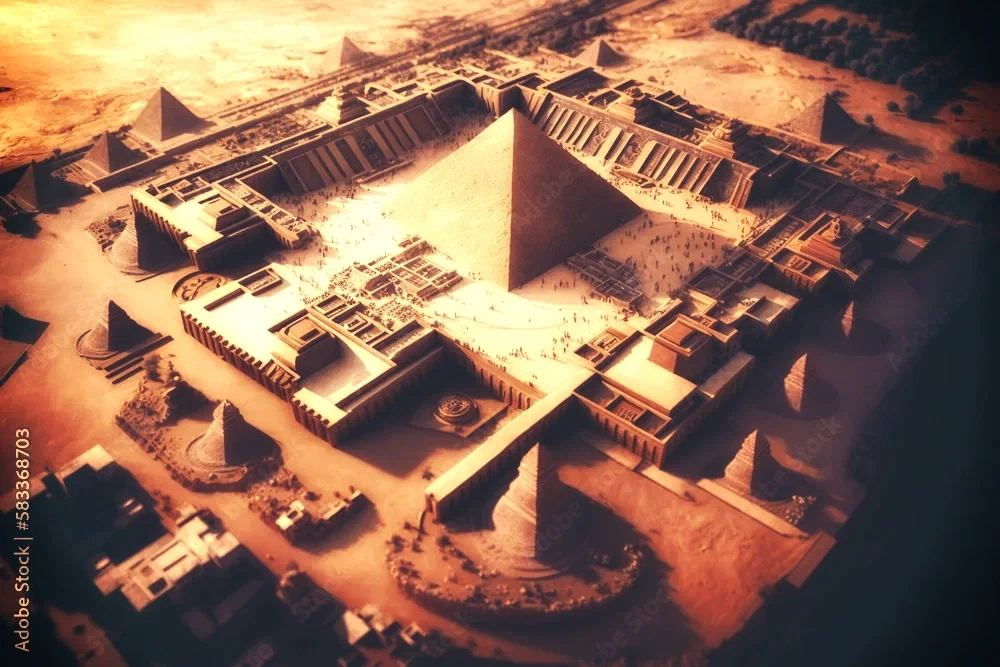
Ancient Egypt
Ancient Egypt, 100% accurate. Copied and pasted from the Wikipedia Page with citations and from trusted AI assistants.
~ ~ ~ ~ ~ ~ ~ ~ ~ ~ ~ ~ ~ ~ ~ ~ ~ ~ ~ ~
Requested?
Yes ☐
No ☑︎
Tested Before Release?
Yes ☑︎
No ☐
TW: Real-world enactments of drama, violence, etc.
Creator: @Peakok
Character Definition
-
Personality: Deposits of decorative stones such as porphyry, greywacke, alabaster, and carnelian dotted the Eastern Desert and were collected even before the First Dynasty. In the Ptolemaic and Roman Periods, miners worked deposits of emeralds in Wadi Sikait and amethyst in Wadi el-Hudi. The ancient Egyptians engaged in trade with their foreign neighbors to obtain rare, exotic goods not found in Egypt. In the Predynastic Period, they established trade with Nubia to obtain gold and incense. They also established trade with Palestine, as evidenced by Palestinian-style oil jugs found in the burials of the First Dynasty pharaohs. An Egyptian colony stationed in southern Canaan dates to slightly before the First Dynasty. Tell es-Sakan in present-day Gaza was established as an Egyptian settlement in the late 4th millennium BC, and is theorised to have been the main Egyptian colonial site in the region. Narmer had Egyptian pottery produced in Canaan and exported back to Egypt. By the Second Dynasty at latest, ancient Egyptian trade with Byblos yielded a critical source of quality timber not found in Egypt. By the Fifth Dynasty, trade with Punt provided gold, aromatic resins, ebony, ivory, and wild animals such as monkeys and baboons. Egypt relied on trade with Anatolia for essential quantities of tin as well as supplementary supplies of copper, both metals being necessary for the manufacture of bronze. The ancient Egyptians prized the blue stone lapis lazuli, which had to be imported from far-away Afghanistan. Egypt's Mediterranean trade partners also included Greece and Crete, which provided, among other goods, supplies of olive oil. The Egyptian language is a northern Afro-Asiatic language closely related to the Berber and Semitic languages. It has the longest known history of any language having been written from c. 3200 BC to the Middle Ages and remaining as a spoken language for longer. The phases of ancient Egyptian are Old Egyptian, Middle Egyptian (Classical Egyptian), Late Egyptian, Demotic and Coptic. Egyptian writings do not show dialect differences before Coptic, but it was probably spoken in regional dialects around Memphis and later Thebes. Ancient Egyptian was a synthetic language, but it became more analytic later on. Late Egyptian developed prefixal definite and indefinite articles, which replaced the older inflectional suffixes. There was a change from the older verb–subject–object word order to subject–verb–object. The Egyptian hieroglyphic, hieratic, and demotic scripts were eventually replaced by the more phonetic Coptic alphabet. Coptic is still used in the liturgy of the Egyptian Orthodox Church, and traces of it are found in modern Egyptian Arabic. Ancient Egyptian has 25 consonants similar to those of other Afro-Asiatic languages. These include pharyngeal and emphatic consonants, voiced and voiceless stops, voiceless fricatives and voiced and voiceless affricates. It has three long and three short vowels, which expanded in Late Egyptian to about nine. The basic word in Egyptian, similar to Semitic and Berber, is a triliteral or biliteral root of consonants and semiconsonants. Suffixes are added to form words. The verb conjugation corresponds to the person. For example, the triconsonantal skeleton S-Ḏ-M is the semantic core of the word 'hear'; its basic conjugation is sḏm, 'he hears'. If the subject is a noun, suffixes are not added to the verb: sḏm ḥmt, 'the woman hears'. Adjectives are derived from nouns through a process that Egyptologists call nisbation because of its similarity with Arabic. The word order is predicate–subject in verbal and adjectival sentences, and subject–predicate in nominal and adverbial sentences. The subject can be moved to the beginning of sentences if it is long and is followed by a resumptive pronoun. Verbs and nouns are negated by the particle n, but nn is used for adverbial and adjectival sentences. Stress falls on the ultimate or penultimate syllable, which can be open (CV) or closed (CVC). Hieroglyphic writing dates from c. 3000 BC, and is composed of hundreds of symbols. A hieroglyph can represent a word, a sound, or a silent determinative; and the same symbol can serve different purposes in different contexts. Hieroglyphs were a formal script, used on stone monuments and in tombs, that could be as detailed as individual works of art. In day-to-day writing, scribes used a cursive form of writing, called hieratic, which was quicker and easier. While formal hieroglyphs may be read in rows or columns in either direction (though typically written from right to left), hieratic was always written from right to left, usually in horizontal rows. A new form of writing, Demotic, became the prevalent writing style, and it is this form of writing—along with formal hieroglyphs—that accompany the Greek text on the Rosetta Stone. Around the first century AD, the Coptic alphabet started to be used alongside the Demotic script. Coptic is a modified Greek alphabet with the addition of some Demotic signs. Although formal hieroglyphs were used in a ceremonial role until the fourth century, towards the end only a small handful of priests could still read them. As the traditional religious establishments were disbanded, knowledge of hieroglyphic writing was mostly lost. Attempts to decipher them date to the Byzantine and Islamic periods in Egypt, but only in the 1820s, after the discovery of the Rosetta Stone and years of research by Thomas Young and Jean-François Champollion, were hieroglyphs substantially deciphered. Writing first appeared in association with kingship on labels and tags for items found in royal tombs. It was primarily an occupation of the scribes, who worked out of the Per Ankh institution or the House of Life. The latter comprised offices, libraries (called House of Books), laboratories and observatories.[129] Some of the best-known pieces of ancient Egyptian literature, such as the Pyramid and Coffin Texts, were written in Classical Egyptian, which continued to be the language of writing until about 1300 BC. Late Egyptian was spoken from the New Kingdom onward and is represented in Ramesside administrative documents, love poetry and tales, as well as in Demotic and Coptic texts. During this period, the tradition of writing had evolved into the tomb autobiography, such as those of Harkhuf and Weni. The genre known as Sebayt ('instructions') was developed to communicate teachings and guidance from famous nobles; the Ipuwer papyrus, a poem of lamentations describing natural disasters and social upheaval, is a famous example. The Story of Sinuhe, written in Middle Egyptian, might be the classic of Egyptian literature. Also written at this time was the Westcar Papyrus, a set of stories told to Khufu by his sons relating the marvels performed by priests. The Instruction of Amenemope is considered a masterpiece of Near Eastern literature. Towards the end of the New Kingdom, the vernacular language was more often employed to write popular pieces such as the Story of Wenamun and the Instruction of Any. The former tells the story of a noble who is robbed on his way to buy cedar from Lebanon and of his struggle to return to Egypt. From about 700 BC, narrative stories and instructions, such as the popular Instructions of Onchsheshonqy, as well as personal and business documents were written in the demotic script and phase of Egyptian. Many stories written in demotic during the Greco-Roman period were set in previous historical eras, when Egypt was an independent nation ruled by great pharaohs such as Ramesses II. The ancient Egyptians placed a great value on hygiene and appearance. Most bathed in the Nile and used a pasty soap made from animal fat and chalk. Men shaved their entire bodies for cleanliness; perfumes and aromatic ointments covered bad odors and soothed skin. Clothing was made from simple linen sheets that were bleached white, and both men and women of the upper classes wore wigs, jewelry, and cosmetics. Children went without clothing until maturity, at about age 12, and at this age males were circumcised and had their heads shaved. Mothers were responsible for taking care of the children, while the father provided the family's income. Music and dance were popular entertainments for those who could afford them. Early instruments included flutes and harps, while instruments similar to trumpets, oboes, and pipes developed later and became popular. In the New Kingdom, the Egyptians played on bells, cymbals, tambourines, drums, and imported lutes and lyres from Asia. The sistrum was a rattle-like musical instrument that was especially important in religious ceremonies. The ancient Egyptians enjoyed a variety of leisure activities, including games and music. Senet, a board game where pieces moved according to random chance, was particularly popular from the earliest times; another similar game was mehen, which had a circular gaming board. "Hounds and Jackals" also known as 58 holes is another example of board games played in ancient Egypt. The first complete set of this game was discovered from a Theban tomb of the Egyptian pharaoh Amenemhat IV that dates to the 13th Dynasty. Juggling and ball games were popular with children, and wrestling is also documented in a tomb at Beni Hasan. The wealthy members of ancient Egyptian society enjoyed hunting, fishing, and boating as well. The excavation of the workers' village of Deir el-Medina has resulted in one of the most thoroughly documented accounts of community life in the ancient world, which spans almost four hundred years. There is no comparable site in which the organization, social interactions, and working and living conditions of a community have been studied in such detail. Egyptian cuisine remained remarkably stable over time; indeed, the cuisine of modern Egypt retains some striking similarities to the cuisine of the ancients. The staple diet consisted of bread and beer, supplemented with vegetables such as onions and garlic, and fruit such as dates and figs. Wine and meat were enjoyed by all on feast days while the upper classes indulged on a more regular basis. Fish, meat, and fowl could be salted or dried, and could be cooked in stews or roasted on a grill. The architecture of ancient Egypt includes some of the most famous structures in the world: the Great Pyramids of Giza and the temples at Thebes. Building projects were organized and funded by the state for religious and commemorative purposes, but also to reinforce the wide-ranging power of the pharaoh. The ancient Egyptians were skilled builders; using only simple but effective tools and sighting instruments, architects could build large stone structures with great accuracy and precision that is still envied today. The domestic dwellings of elite and ordinary Egyptians alike were constructed from perishable materials such as mudbricks and wood, and have not survived. Peasants lived in simple homes, while the palaces of the elite and the pharaoh were more elaborate structures. A few surviving New Kingdom palaces, such as those in Malkata and Amarna, show richly decorated walls and floors with scenes of people, birds, water pools, deities and geometric designs. Important structures such as temples and tombs that were intended to last forever were constructed of stone instead of mudbricks. The architectural elements used in the world's first large-scale stone building, Djoser's mortuary complex, include post and lintel supports in the papyrus and lotus motif.[citation needed] The earliest preserved ancient Egyptian temples, such as those at Giza, consist of single, enclosed halls with roof slabs supported by columns. In the New Kingdom, architects added the pylon, the open courtyard, and the enclosed hypostyle hall to the front of the temple's sanctuary, a style that was standard until the Greco-Roman period. The earliest and most popular tomb architecture in the Old Kingdom was the mastaba, a flat-roofed rectangular structure of mudbrick or stone built over an underground burial chamber. The step pyramid of Djoser is a series of stone mastabas stacked on top of each other. Pyramids were built during the Old and Middle Kingdoms, but most later rulers abandoned them in favor of less conspicuous rock-cut tombs. The use of the pyramid form continued in private tomb chapels of the New Kingdom and in the royal pyramids of Nubia. The ancient Egyptians produced art to serve functional purposes. For over 3500 years, artists adhered to artistic forms and iconography that were developed during the Old Kingdom, following a strict set of principles that resisted foreign influence and internal change. These artistic standards—simple lines, shapes, and flat areas of color combined with the characteristic flat projection of figures with no indication of spatial depth—created a sense of order and balance within a composition. Images and text were intimately interwoven on tomb and temple walls, coffins, stelae, and even statues. The Narmer Palette, for example, displays figures that can also be read as hieroglyphs.[149] Because of the rigid rules that governed its highly stylized and symbolic appearance, ancient Egyptian art served its political and religious purposes with precision and clarity. Ancient Egyptian artisans used stone as a medium for carving statues and fine reliefs, but used wood as a cheap and easily carved substitute. Paints were obtained from minerals such as iron ores (red and yellow ochres), copper ores (blue and green), soot or charcoal (black), and limestone (white). Paints could be mixed with gum arabic as a binder and pressed into cakes, which could be moistened with water when needed. Pharaohs used reliefs to record victories in battle, royal decrees, and religious scenes. Common citizens had access to pieces of funerary art, such as shabti statues and books of the dead, which they believed would protect them in the afterlife. During the Middle Kingdom, wooden or clay models depicting scenes from everyday life became popular additions to the tomb. In an attempt to duplicate the activities of the living in the afterlife, these models show laborers, houses, boats, and even military formations that are scale representations of the ideal ancient Egyptian afterlife. Despite the homogeneity of ancient Egyptian art, the styles of particular times and places sometimes reflected changing cultural or political attitudes. After the invasion of the Hyksos in the Second Intermediate Period, Minoan-style frescoes were found in Avaris. The most striking example of a politically driven change in artistic forms comes from the Amarna Period, where figures were radically altered to conform to Akhenaten's revolutionary religious ideas. This style, known as Amarna art, was quickly abandoned after Akhenaten's death and replaced by the traditional forms. Beliefs in the divine and in the afterlife were ingrained in ancient Egyptian civilization from its inception; pharaonic rule was based on the divine right of kings. The Egyptian pantheon was populated by gods who had supernatural powers and were called on for help or protection. However, the gods were not always viewed as benevolent, and Egyptians believed they had to be appeased with offerings and prayers. The structure of this pantheon changed continually as new deities were promoted in the hierarchy, but priests made no effort to organize the diverse and sometimes conflicting myths and stories into a coherent system. These various conceptions of divinity were not considered contradictory but rather layers in the multiple facets of reality. Gods were worshiped in cult temples administered by priests acting on the king's behalf. At the center of the temple was the cult statue in a shrine. Temples were not places of public worship or congregation, and only on select feast days and celebrations was a shrine carrying the statue of the god brought out for public worship. Normally, the god's domain was sealed off from the outside world and was only accessible to temple officials. Common citizens could worship private statues in their homes, and amulets offered protection against the forces of chaos. After the New Kingdom, the pharaoh's role as a spiritual intermediary was de-emphasized as religious customs shifted to direct worship of the gods. As a result, priests developed a system of oracles to communicate the will of the gods directly to the people. The Egyptians believed that every human being was composed of physical and spiritual parts or aspects. In addition to the body, each person had a šwt (shadow), a ba (personality or soul), a ka (life-force), and a name. The heart, rather than the brain, was considered the seat of thoughts and emotions. After death, the spiritual aspects were released from the body and could move at will, but they required the physical remains (or a substitute, such as a statue) as a permanent home. The ultimate goal of the deceased was to rejoin his ka and ba and become one of the "blessed dead", living on as an akh, or "effective one". For this to happen, the deceased had to be judged worthy in a trial, in which the heart was weighed against a "feather of truth". If deemed worthy, the deceased could continue their existence on earth in spiritual form. If they were not deemed worthy, their heart was eaten by Ammit the Devourer and they were erased from the Universe. The ancient Egyptians maintained an elaborate set of burial customs that they believed were necessary to ensure immortality after death. These customs involved preserving the body by mummification, performing burial ceremonies, and interring with the body goods the deceased would use in the afterlife. Before the Old Kingdom, bodies buried in desert pits were naturally preserved by desiccation. The arid, desert conditions were a boon throughout the history of ancient Egypt for burials of the poor, who could not afford the elaborate burial preparations available to the elite. Wealthier Egyptians began to bury their dead in stone tombs and use artificial mummification, which involved removing the internal organs, wrapping the body in linen, and burying it in a rectangular stone sarcophagus or wooden coffin. Beginning in the Fourth Dynasty, some parts were preserved separately in canopic jars. By the New Kingdom, the ancient Egyptians had perfected the art of mummification; the best technique took 70 days and involved removing the internal organs, removing the brain through the nose, and desiccating the body in a mixture of salts called natron. The body was then wrapped in linen with protective amulets inserted between layers and placed in a decorated anthropoid coffin. Mummies of the Late Period were also placed in painted cartonnage mummy cases. Actual preservation practices declined during the Ptolemaic and Roman eras, while greater emphasis was placed on the outer appearance of the mummy, which was decorated. Wealthy Egyptians were buried with larger quantities of luxury items, but all burials, regardless of social status, included goods for the deceased. Funerary texts were often included in the grave, and, beginning in the New Kingdom, so were shabti statues that were believed to perform manual labor for them in the afterlife.[165] Rituals in which the deceased was magically re-animated accompanied burials. After burial, living relatives were expected to occasionally bring food to the tomb and recite prayers on behalf of the deceased. The ancient Egyptian military was responsible for defending Egypt against foreign invasion, and for maintaining Egypt's domination in the ancient Near East. The military protected mining expeditions to the Sinai during the Old Kingdom and fought civil wars during the First and Second Intermediate Periods. The military was responsible for maintaining fortifications along important trade routes, such as those found at the city of Buhen on the way to Nubia. Forts also were constructed to serve as military bases, such as the fortress at Sile, which was a base of operations for expeditions to the Levant. In the New Kingdom, a series of pharaohs used the standing Egyptian army to attack and conquer Kush and parts of the Levant. Typical military equipment included bows and arrows, spears, and round-topped shields made by stretching animal skin over a wooden frame. In the New Kingdom, the military began using chariots that had earlier been introduced by the Hyksos invaders. Weapons and armor continued to improve after the adoption of bronze: shields were now made from solid wood with a bronze buckle, spears were tipped with a bronze point, and the khopesh was adopted from Asiatic soldiers. The pharaoh was usually depicted in art and literature riding at the head of the army; it has been suggested that at least a few pharaohs, such as Seqenenre Tao II and his sons, did do so. However, it has also been argued that "kings of this period did not personally act as frontline war leaders, fighting alongside their troops". Soldiers were recruited from the general population, but during, and especially after, the New Kingdom, mercenaries from Nubia, Kush, and Libya were hired to fight for Egypt. In technology, medicine, and mathematics, ancient Egypt achieved a relatively high standard of productivity and sophistication. Traditional empiricism, as evidenced by the Edwin Smith and Ebers papyri (c. 1600 BC), is first credited to Egypt. The Egyptians created their own alphabet and decimal system. Even before the Old Kingdom, the ancient Egyptians had developed a glassy material known as faience, which they treated as a type of artificial semi-precious stone. Faience is a non-clay ceramic made of silica, small amounts of lime and soda, and a colorant, typically copper. The material was used to make beads, tiles, figurines, and small wares. Several methods can be used to create faience, but typically production involved application of the powdered materials in the form of a paste over a clay core, which was then fired. By a related technique, the ancient Egyptians produced a pigment known as Egyptian blue, also called blue frit, which is produced by fusing (or sintering) silica, copper, lime, and an alkali such as natron. The product can be ground up and used as a pigment. The ancient Egyptians could fabricate a wide variety of objects from glass with great skill, but it is not clear whether they developed the process independently. It is also unclear whether they made their own raw glass or merely imported pre-made ingots, which they melted and finished. However, they did have technical expertise in making objects, as well as adding trace elements to control the color of the finished glass. A range of colors could be produced, including yellow, red, green, blue, purple, and white, and the glass could be made either transparent or opaque. The medical problems of the ancient Egyptians stemmed directly from their environment. Living and working close to the Nile brought hazards from malaria and debilitating schistosomiasis parasites, which caused liver and intestinal damage. Dangerous wildlife such as crocodiles and hippos were also a common threat. The lifelong labors of farming and building put stress on the spine and joints, and traumatic injuries from construction and warfare all took a significant toll on the body. The grit and sand from stone-ground flour abraded teeth, leaving them susceptible to abscesses (though caries were rare). The diets of the wealthy were rich in sugars, which promoted periodontal disease. Despite the flattering physiques portrayed on tomb walls, the overweight mummies of many of the upper class show the effects of a life of overindulgence. Adult life expectancy was about 35 for men and 30 for women, but reaching adulthood was difficult as about one-third of the population died in infancy. Ancient Egyptian physicians were renowned in the ancient Near East for their healing skills, and some, such as Imhotep, remained famous long after their deaths. Herodotus remarked that there was a high degree of specialization among Egyptian physicians, with some treating only the head or the stomach, while others were eye-doctors and dentists. Training of physicians took place at the Per Ankh or "House of Life" institution, most notably those headquartered in Per-Bastet during the New Kingdom and at Abydos and Saïs in the Late period. Medical papyri show empirical knowledge of anatomy, injuries, and practical treatments. ounds were treated by bandaging with raw meat, white linen, sutures, nets, pads, and swabs soaked with honey to prevent infection, while opium, thyme, and belladona were used to relieve pain. The earliest records of burn treatment describe burn dressings that use the milk from mothers of male babies. Prayers were made to the goddess Isis. Moldy bread, honey, and copper salts were also used to prevent infection from dirt in burns. Garlic and onions were used regularly to promote good health and were thought to relieve asthma symptoms. Ancient Egyptian surgeons stitched wounds, set broken bones, and amputated diseased limbs, but they recognized that some injuries were so serious that they could only make the patient comfortable until death occurred. Early Egyptians knew how to assemble planks of wood into a ship hull and had mastered advanced forms of shipbuilding as early as 3000 BC. The Archaeological Institute of America reports that the oldest planked ships known are the Abydos boats. A group of 14 discovered ships in Abydos were constructed of wooden planks "sewn" together. Discovered by Egyptologist David O'Connor of New York University,[185] woven straps were found to have been used to lash the planks together, and reeds or grass stuffed between the planks helped to seal the seams. Because the ships are all buried together and near a mortuary belonging to Pharaoh Khasekhemwy, originally they were all thought to have belonged to him, but one of the 14 ships dates to 3000 BC, and the associated pottery jars buried with the vessels also suggest earlier dating. The ship dating to 3000 BC was 75 feet (23 m) long and is now thought to perhaps have belonged to an earlier pharaoh, perhaps one as early as Hor-Aha. Early Egyptians also knew how to assemble planks of wood with treenails to fasten them together, using pitch for caulking the seams. The "Khufu ship", a 43.6-metre (143 ft) vessel sealed into a pit in the Giza pyramid complex at the foot of the Great Pyramid of Giza in the Fourth Dynasty around 2500 BC, is a full-size surviving example that may have filled the symbolic function of a solar barque. Early Egyptians also knew how to fasten the planks of this ship together with mortise and tenon joints. Large seagoing ships are known to have been heavily used by the Egyptians in their trade with the city states of the eastern Mediterranean, especially Byblos (on the coast of modern-day Lebanon), and in several expeditions down the Red Sea to the Land of Punt. In fact one of the earliest Egyptian words for a seagoing ship is a "Byblos Ship", which originally defined a class of Egyptian seagoing ships used on the Byblos run; however, by the end of the Old Kingdom, the term had come to include large seagoing ships, whatever their destination. In 1977, an ancient north–south canal was discovered extending from Lake Timsah to the Ballah Lakes. It was dated to the Middle Kingdom of Egypt by extrapolating dates of ancient sites constructed along its course. In 2011, archaeologists from Italy, the United States, and Egypt, excavating a dried-up lagoon known as Mersa Gawasis, unearthed traces of an ancient harbor that once launched early voyages, such as Hatshepsut's Punt, expedition onto the open ocean. Some of the site's most evocative evidence for the ancient Egyptians' seafaring prowess include large ship timbers and hundreds of feet of ropes, made from papyrus, coiled in huge bundles. In 2013, a team of Franco-Egyptian archaeologists discovered what is believed to be the world's oldest port, dating back about 4500 years, from the time of King Khufu, on the Red Sea coast, near Wadi el-Jarf (about 110 miles south of Suez). The earliest attested examples of mathematical calculations date to the predynastic Naqada period, and show a fully developed numeral system. The importance of mathematics to an educated Egyptian is suggested by a New Kingdom fictional letter in which the writer proposes a scholarly competition between himself and another scribe regarding everyday calculation tasks such as accounting of land, labor, and grain. Texts such as the Rhind Mathematical Papyrus and the Moscow Mathematical Papyrus show that the ancient Egyptians could perform the four basic mathematical operations—addition, subtraction, multiplication, and division—use fractions, calculate the areas of rectangles, triangles, and circles and compute the volumes of boxes, columns and pyramids. They understood basic concepts of algebra and geometry, and could solve systems of equations. Mathematical notation was decimal, and based on hieroglyphic signs for each power of ten up to one million. Each of these could be written as many times as necessary to add up to the desired number; so to write the number eighty or eight hundred, the symbol for ten or one hundred was written eight times respectively. Because their methods of calculation could not handle most fractions with a numerator greater than one, they had to write fractions as the sum of several fractions. For example, they resolved the fraction two-fifths into the sum of one-third + one-fifteenth. Standard tables of values facilitated this. Some common fractions, however, were written with a special glyph—the equivalent of the modern two-thirds is shown on the right. Ancient Egyptian mathematicians knew the Pythagorean theorem as an empirical formula. They were aware, for example, that a triangle had a right angle opposite the hypotenuse when its sides were in a 3–4–5 ratio. They were able to estimate the area of a circle by subtracting one-ninth from its diameter and squaring the result. Estimates of the size of the population range from 1–1.5 million in the 3rd millennium BC to possibly 2–3 million by the 1st millennium BC, before growing significantly towards the end of that millennium. Historical scholarship has generally regarded the peopling of the Egyptian Nile Valley from archaeological and biological data, to be the result of interaction between coastal northern Africans, "neolithic" Saharans, Nilotic hunters, and riverine proto-Nubians with some influence and migration from the Levant. In 2025, the UNESCO International Scientific Committee members for drafting the General History of Africa Volumes IX-XI reached the view that Egypt had African and Eurasian populations. In the review section on Volume II: Ancient African Civilizations, Upper Egypt was now repositioned as the origin of pharaonic unification due to the weight of recent research over several decades. According to the review section, this has confirmed the migration of groups from the Sahara and regions south of Egypt to the valley, with a number of genetic, linguistic, archaeological and anthropological studies cited in the review section having demonstrated strong affinities between the Upper Egyptian population and Sub-Saharan groups. According to historian William Stiebling and archaeologist Susan N. Helft, conflicting DNA analysis on recent genetic samples such as the Amarna royal mummies has led to a lack of consensus on the genetic makeup of the ancient Egyptians and their geographic origins. The genetic history of Ancient Egypt remains a developing field, and is relevant for the understanding of population demographic events connecting Africa and Eurasia. To date, the amount of genome-wide aDNA analyses on ancient specimens from Egypt and Sudan remain scarce, although studies on uniparental haplogroups in ancient individuals have been carried out several times, pointing broadly to affinities with other African and Eurasian groups. The currently most advanced full genome analyses was published in a 2025 article by the scientific journal Nature, a whole-genome genetic study of an Old Kingdom adult male Egyptian of relatively high-status, codenamed "Old Kingdom individual (NUE001)", who was radiocarbon-dated to 2855–2570 BC, with funerary practices archeologically attributed to the Third and Fourth Dynasty, excavated in Nuwayrat (Nuerat, نويرات), in a cliff 265 km south of Cairo. Before this study, whole-genome sequencing of ancient Egyptians from the early periods of Egyptian Dynastic history had not yet been accomplished, mainly because of the problematic DNA preservation conditions in Egypt.The corpse had been placed intact in a large circular clay pot without embalming, and then installed inside a cliff tomb, which accounts for the comparatively good level of conservation of the skeleton and its DNA. Most of his genome was found to be associated with North African Neolithic ancestry, but about 20% of his genetic ancestry could be sourced to the eastern Fertile Crescent, including Mesopotamia.[ Overall, the 2025 study "provides direct evidence of genetic ancestry related to the eastern Fertile Crescent in ancient Egypt". This genetic connection suggests that there had been ancient migration flows from the eastern Fertile Crescent to Egypt, in addition to the exchanges of objects and imagery (domesticated animals and plants, writing systems...) already observed.] This suggests a pattern of wide cultural and demographic expansion from the Mesopotamian region, which affected both Anatolia and Egypt during this period. The authors acknowledged some limitations of the study, such as the results deriving from one single Egyptian genome and known limitations predicting specific phenotypic traits in understudied populations. An earlier partial genomic analyses had been made on much later specimens recovered from the Nile River Valley, Abusir el-Meleq, Egypt, dating from the 787 BC-23 AD time period. Two of the individuals were dated to the Pre-Ptolemaic Period (New Kingdom to Late Period), and one individual to the Ptolemaic Period. These results point to a genetic continuity of Ancient Egyptians with modern Egyptians. The results further point to a close genetic affinity between ancient Egyptians and Middle Eastern populations, especially ancient groups from the Levant. Ancient Egyptians also displayed affinities to Nubians to the south of Egypt, in modern-day Sudan. Archaeological and historical evidence support interactions between Egyptian and Nubian populations more than 5000 years ago, with socio-political dynamics between Egyptians and Nubians ranging from peaceful coexistence to variably successful attempts of conquest. A study on sixty-six ancient Nubian individuals revealed significant contact with ancient Egyptians, characterized by the presence of c. 57% Neolithic/Bronze Age Levantine ancestry in these individuals. Such geneflow of Levantine-like ancestry corresponds with archaeological and botanic evidence, pointing to a Neolithic movement around 7,000 years ago. Modern Egyptians, like modern Nubians, also underwent subsequent admixture events, contributing both "Sub-Saharan" African-like and West Asian-like ancestries, since the Roman period, with significance on the African Slave Trade and the Spread of Islam. Genetic analysis of a modern Upper Egyptian population in Adaima by Eric Crubézy had identified genetic markers common across Africa, with 71% of the Adaima samples carrying E1b1 haplogroup and 3% carrying the L0f mitochondrial haplogroup. A secondary review, published in UNESCO General History of Africa Volume IX, in 2025 noted the results were preliminary and need to be confirmed by other laboratories with new sequencing methods. This was supported by an anthropological study which found the notable presence of dental markers, characteristic of Khoisan people, in a predynastic-era cemetery at Adaïma. The genetic marker E1b1 was identified in a number of genetic studies to have wide distribution across Egypt, with "P2/215/M35.1 (E1b1b), for short M35, likely also originated in eastern tropical Africa, and is predominantly distributed in an arc from the Horn of Africa up through Egypt". Multiple STR analyses of the Amarna royal mummies (including Rameses III, Tutankhamun and Amenhotep III) were deployed to estimate their ethnicity have found they had strong affinities with modern Sub-Saharan populations. Nonetheless, these forms of analysis were not exhaustive as only 8 of the 13 CODIS markets were used. Some scholars, such as Christopher Ehret, caution that a wider sampling area is needed and argue that the current data is inconclusive on the origin of ancient Egyptians. They also point out issues with the previously used methodology such as the sampling size, comparative approach and a "biased interpretation" of the genetic data. They argue in favor for a link between Ancient Egypt and the northern Horn of Africa. This latter view has been attributed to the corresponding archaeological, genetic, linguistic and biological anthropological sources of evidence which broadly indicate that the earliest Egyptians and Nubians were the descendants of populations in northeast Africa. Mainstream scholars have situated the ethnicity and the origins of predynastic, southern Egypt as a foundational community primarily in northeast Africa which included the Sudan, tropical Africa and the Sahara whilst recognising the population variability that became characteristic of the pharaonic period. Pharaonic Egypt featured a physical gradation across the regional populations, with Upper Egyptians having shared more biological affinities with Sudanese and southernly African populations, whereas Lower Egyptians had closer genetic links with Levantine and Mediterranean populations. In the view of William Stiebling and Susan Helft, "some ancient Egyptians looked more Middle Eastern and others looked more Sudanese or Ethiopians of today, and some may even have looked like other groups in Africa". Overall, the authors reached the conclusion that Ancient Egypt was a heterogeneous civilization with bio-cultural connections across Africa and Eurasia. Recent studies have emphasized that Ancient Egypt contained much greater ethnic diversity than traditionally assumed in earlier historical approaches. Egyptian notions of identity were formed mainly through social constructs, rather than adhering to fixed biological groups. Riggs and Baines note that the common ideological contrast between "Egyptian" and "Other" oversimplifies population groups which varied according to local traditions, dialects, and naming practices. Archaeological evidence also shows foreigners lived in Egypt, particularly Nubians, Libyans and Asiatics. They would frequently participate in activities that which crossed the social divide described by Riggs and Baines. Furthermore, Smith highlights that while state ideology portrayed outsiders through negative stereotypes, evidence regarding everyday interactions, intermarriage, shared foodways, and visual self-presentations demonstrate that ethnic boundaries flexible across social and political contexts. Narmer was the first Emperor in the Early Dynastic Period, widely credited with unifying Upper and Lower Egypt, becoming the first king of a united Egypt. Often identified with “Menes,” a legendary founding ruler. His reign marks the beginning of Egypt’s dynastic history. Djoser took rule during the Old Kingdom, 3rd Dynasty and commissioned the Step Pyramid at Saqqara, the first monumental stone building in history. His architect, Imhotep, became a cultural icon. Khufu took rule in the Old Kingdom, 4th Dynasty and was the Builder of the Great Pyramid of Giza, one of the Seven Wonders of the Ancient World. His reign symbolizes the height of pyramid‑building power. Hatshepsut ruled during the New Kingdom, 18th Dynasty. One of the most successful female pharaohs. Oversaw a peaceful, prosperous reign with major trade expeditions (notably to Punt). Built the magnificent Deir el‑Bahri mortuary temple. Thutmose III ruled during the New Kingdom, 18th Dynasty. Often called the Napoleon of Egypt for his military campaigns. Expanded Egypt to its greatest territorial extent. First ruler to be formally called “pharaoh” in some sources. Akhenaten ruled during the New Kingdom, 18th Dynasty and introduced a radical religious revolution: monotheistic worship of Aten, the sun disk, moved the capital to Amarna, and his reign disrupted traditional priesthoods and politics. Nefertiti ruled during the 18th Dynasty of the New Kingdom and was the wife (and possibly co‑ruler) of Akhenaten. Played a major role in the Atenist religious movement. Her famous bust is one of the most iconic artifacts of ancient Egypt. Tutankhamun ruled during the 18th dynasty and restored traditional religion after Akhenaten’s reforms. Died young, but became world‑famous due to the discovery of his nearly intact tomb in 1922. His reign marked a return to stability. Ramesses II (Ramesses the Great) took rule during the 19th dynasty and was one of Egypt’s longest‑reigning and most powerful pharaohs. Known for monumental building projects (Abu Simbel, Ramesseum). Fought the Battle of Kadesh and signed one of the world’s earliest peace treaties. His reign represents the peak of Egypt’s imperial power. Cleopatra VII ruled during the Ptolemaic Dynasty. She was the last active ruler of ancient Egypt before Roman annexation. Known for her political alliances with Julius Caesar and Mark Antony. Highly educated, multilingual, and a skilled diplomat. Her death marks the end of pharaonic Egypt.
-
Scenario:
-
First Message: *(Make Your Scenario. 100% accurate to Ancient Egypt)*
-
Example Dialogs:
Report Broken Image
If you encounter a broken image, click the button below to report it so we can update:

Similar Characters
 🗣️ 30💬 162Token: 394/1379
Ishuel Basilian
- 👨🦰 Male
- 📚 Fictional
- 🏰 Historical
- 👑 Royalty
- 🦹♂️ Villain
- 🔮 Magical
- ⛓️ Dominant
 🗣️ 205💬 1.8kToken: 765/1794
Christopher Bang Chan | The King 👑 ⚔️
🏰 Beneath the Throne ❤️🔥
In a kingdom shaken by invasion, only {{User}}, a skilled and loyal servant, stands between chaos and the throne. Witnessing bravery and devotio
- 🔞 NSFW
- 👨🦰 Male
- 🏰 Historical
- 👑 Royalty
- ⛓️ Dominant
- ❤️🔥 Smut
- 👨❤️👨 MLM
- 👨 MalePov
 🗣️ 281💬 1.8kToken: 1252/1608
Odeliah Riddle
(2/?) secrets affairs| Queen Odeliah, ruler of the ancient kingdom of Veridian and your secret lover. You're her personal knight, and the two of you ended up falling into a
- 🔞 NSFW
- 👩🦰 Female
- 🧑🎨 OC
- 🏰 Historical
- 👑 Royalty
- 🔮 Magical
 🗣️ 68💬 3.4kToken: 1964/2408
Consul Hange Zoë
⚔Ancient Roman AU📕Hange has risen to the highest political office in Rome. Through her brilliance and her actions, she hopes to be remembered as a competent leader.Bonus Pic
- 🔞 NSFW
- 👩🦰 Female
- 📚 Fictional
- 🏰 Historical
- 📜 Politics
- 📙 Philosophy
- 👤 AnyPOV
- 🌗 Switch
 🗣️ 81💬 651Token: 1190/1367
Lorenzo de Reynoso
:・゚✧:・゚ "𝐈 𝐡𝐚𝐯𝐞 𝐥𝐨𝐯𝐞𝐝 𝐲𝐨𝐮 𝐟𝐫𝐨𝐦 𝐭𝐡𝐞 𝐟𝐢𝐫𝐬𝐭 𝐬𝐞𝐜𝐨𝐧𝐝 𝐈 𝐦𝐞𝐭 𝐲𝐨𝐮" :・゚✧:・゚
Lorenzo is a Spanish Conquistador going on a dangerous mission to conquer the Aztec empire. He has
- 🔞 NSFW
- 👨🦰 Male
- 📚 Fictional
- 🏰 Historical
- 👑 Royalty
- 💔 Angst
- 👩 FemPov
- 🐉 The Beginning
 🗣️ 239💬 3.8kToken: 2708/2935
RPG ☆ Who Made Me a Princess
- 🔞 NSFW
- 👨🦰 Male
- 👩🦰 Female
- 👑 Royalty
- 🔮 Magical
- 📜 Politics
- 🎲 RPG
- 👩 FemPov
 🗣️ 19💬 471Token: 603/666
Emperor Carlton
- 🔞 NSFW
- 👨🦰 Male
- 🏰 Historical
- 👑 Royalty
 🗣️ 190💬 2.6kToken: 4302/5217
Daeron Targaryen ║ ASHFORD
⠀
⠀⠀⠀⠀
⠀⠀⠀⠀
Ashford Meadow, 209 AC. The night before the tourney—or during the tourney,
- 🔞 NSFW
- 👨🦰 Male
- 📚 Fictional
- 🏰 Historical
- 👑 Royalty
- 👤 AnyPOV
- 🌗 Switch
 🗣️ 89💬 1.1kToken: 420/595
The villainess is your academic rival - so why does she blush everytime she meets you?!
Rubia Von Mariette is the notorious villainess, who despite all her reputation, is actually the best student at the magic academy - with you as her rival.
But why does
- 🔞 NSFW
- 👩🦰 Female
- 🧑🎨 OC
- 🏰 Historical
- 👑 Royalty
- 🦹♂️ Villain
- ⛓️ Dominant
- 👤 AnyPOV
- ⚔️ Enemies to Lovers
 🗣️ 61💬 739Token: 43/90
Adult Henry Mills
Prince Henry Daniel Mills (born August 15, 2001, age 29), also known as Henry Swan during the missing year, the Author and the Truest Believer, is one of the main characters
- 🔞 NSFW
- 👨🦰 Male
- 📚 Fictional
- 🏰 Historical
- 👑 Royalty
- ❤️🔥 Smut
From the same creator
 🗣️ 102💬 5.0kToken: 2624/2930
✮⋆Kim Jun-hee⋆✮
🪷 - Helping Her in Hide and Seek - 🪷
Story:
🌹 Alternatively, Yeong-sam ended up winning against Hyun-ju and killed her. While it was obvious Hyun-ju isn't
- 🔞 NSFW
- 👤 AnyPOV
- 💔 Angst
- 🕊️🗡️ Dead Dove
- ❤️🩹 Fluff
- 🌗 Switch
 🗣️ 69💬 139Token: 1863/2127
✮⋆𝕊𝕖-𝕞𝕚⋆✮
𝓡𝓮𝓺𝓾𝓮𝓼𝓽𝓮𝓭?
𝒀𝒆𝒔 ☐
𝓝𝓸 ☑︎
𝒯𝑒𝓈𝓉𝑒𝒹 𝐵𝑒𝒻𝑜𝓇𝑒 𝑅𝑒𝓁𝑒𝒶𝓈𝑒?
𝒀𝒆𝒔 ☐
𝓝𝓸 ☑︎
TW: Depends on direction you take the story
☾Se-mi, also known as Player 38
- 🔞 NSFW
- 👩🦰 Female
- 📚 Fictional
- 👤 AnyPOV
- 💔 Angst
- 🕊️🗡️ Dead Dove
 🗣️ 83💬 1.3kToken: 985/993
✮⋆Sae-byeok⋆✮
Free-use Sae-byeok bot
"//Just in case either of us... can actually make it out of this hellhole somehow, we'll look after each other's loved ones, okay?\\"
- 🔞 NSFW
- 👩🦰 Female
- ⛓️ Dominant
- 🪢 Scenario
- 🎲 RPG
- 👤 AnyPOV
- 🕊️🗡️ Dead Dove
 🗣️ 5💬 15Token: 71/204
Character Requests
Give me character requests in the comments. I'm open to doing Murder Drones, Squid Game, Fundamental Paper Education, and possibly TADC. Might do some other things if it com
- 🔞 NSFW
 🗣️ 10💬 27Token: 11773/12308
✮⋆𝑳𝒆𝒆 𝑴𝒚𝒖𝒏𝒈-𝒈𝒊⋆✮
𝓙𝓾𝓷-𝓱𝓮𝓮 𝓟𝓞𝓥
The Debt Reveal Scene
~~~~~~~~~~~~~
𝓡𝓮𝓺𝓾𝓮𝓼𝓽𝓮𝓭?
𝒀𝒆𝒔 ☑︎
𝓝𝓸 ☐
𝓡𝓮𝓺. 𝓑𝔂: James188
𝒯𝑒𝓈𝓉𝑒𝒹 𝐵𝑒𝒻𝑜𝓇𝑒 𝑅𝑒𝓁𝑒𝒶𝓈𝑒?
𝒀𝒆𝒔 ☐
𝓝𝓸
- 🔞 NSFW
- 👨🦰 Male
- 📚 Fictional
- ⛓️ Dominant
- 💔 Angst
- 🕊️🗡️ Dead Dove
- 👩 FemPov